
Hecamede
Haliday, 1837
Species Guides
1Hecamede is a of shore flies in the Ephydridae, first described by Haliday in 1837. The genus is distributed across the Palearctic region, with records from Europe, North Africa, the Middle East, and Japan. in this genus are associated with saline or alkaline wetland . The genus name derives from Greek mythology, specifically a figure in Homer's Iliad.
Pronunciation
How to pronounce Hecamede: //ˌhɛkəˈmiːdeɪ//
These audio files are automatically generated. While they are not always 100% accurate, they are a good starting point.
Identification
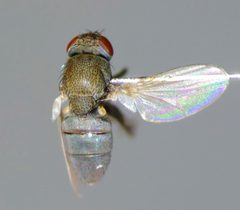
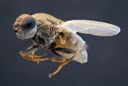
Hecamede are small to minute shore flies, generally 2-4 mm in length. They can be distinguished from other ephydrid by specific combinations of chaetotaxy (bristle arrangement) on the and , and details of wing venation including the position and development of crossveins. The genus is part of the tribe Hecamedini, characterized by reduced or modified mouthparts and adaptations to harsh saline environments. Precise identification to species level requires examination of male terminalia.
Images
Habitat
Associated with saline, alkaline, or mineral-rich aquatic environments including salt marshes, saline lakes, and coastal wetlands. Egyptian records specifically document occurrence in coastal zones, desert springs, and inland saline lakes such as Lake Qaroun.
Distribution
Palearctic distribution. Recorded from: Azores, Belgium, Bulgaria, Canary Islands, Denmark, Egypt, France, Germany, Great Britain, Greece, Italy, Japan, Madeira, Mallorca, Netherlands, Norway, Poland, Romania, Russia (European), Spain, and Sweden. In Egypt, documented from the Coastal Strip (Alexandria, Abu-Qir, Burg El-Arab, Mariout), Eastern Desert (El-Ain El-Sokhna, Fayed, Ghardaga, Ismailia, Safaga), Fayoum (Lake Qaroun), Gebel Elba (Halayeb, Wadi Salat), and Sinai (El-Arish).
Ecological Role
Member of the ephydrid in saline wetland . As with other Ephydridae, larvae likely contribute to nutrient cycling in extreme saline where few other insect persist. may serve as prey for other arthropods and small vertebrates in these environments.
Similar Taxa
- Other Ephydridae generaHecamede is distinguished from closely related in tribe Hecamedini (e.g., Ephydra, Scatella) by specific chaetotactic patterns and wing venation details; requires microscopic examination for reliable separation.
- Other Diptera in saline habitatsMay co-occur with dolichopodid flies and other shore flies; distinguished by -level characters including reduced wing venation with anal break and specific antennal structure.
More Details
Etymology
The name references Hecamede (Ἑκαμήδη), a figure in Homer's Iliad, daughter of Arsinoos, captured from Tenedos and given to King Nestor as a serving woman. This follows a pattern in Ephydridae where Haliday and other early dipterists applied classical Greek names to genera.
Taxonomic history
Established by Alexander Henry Haliday in 1837. The has been revised by Mathis (1993) for the Egyptian fauna, documenting seven in the region. The tribe Hecamedini, containing Hecamede, is characterized by morphological adaptations to hypersaline environments.