
Drosophila guttifera
Walker, 1849
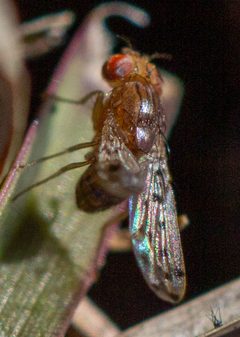
Drosophila guttifera is a of vinegar fly in the Drosophila quinaria species group, notable for its distinctive polka-dotted wing pigmentation pattern. The species feeds on rotting mushrooms and has become an important model organism for studying the genetic mechanisms underlying complex morphological pattern formation. Its was sequenced in 2015, revealing how cis-regulatory enhancers drive wing pattern development. Research has demonstrated that the wing spot pattern shows thermal plasticity and is regulated by the wingless morphogen, while the yellow and tan genes are co-expressed to produce the abdominal and wing melanin spot patterns.
Pronunciation
How to pronounce Drosophila guttifera: /drəˈsɒfɪlə ˌɡʌtɪˈfɪərə/
These audio files are automatically generated. While they are not always 100% accurate, they are a good starting point.
Identification
Distinguished from other Drosophila by its sexually polka-dotted wing pigmentation pattern, consisting of multiple dark spots on a clear wing background. The displays six longitudinal rows of melanin spots. Wing spots are smaller relative to overall wing size when reared at lower temperatures due to thermal plasticity. Similar to other quinaria group species in general body plan but readily identified by the unique spotted wing pattern.
Images
Habitat
Associated with environments where rotting mushrooms occur; specific microhabitat details not well documented in available sources.
Diet
Feeds on rotting mushrooms.
Life Cycle
Development includes a pupal period during which wing spot pattern specification occurs; the most sensitive stage for thermal plasticity of spot size occurs during part of the pupal period when wingless morphogen is expressed in the polka-dotted pattern.
Behavior
Requires light conditions for mating; no mating occurs in complete darkness. No courtship sound has been observed, indicating reliance on visual cues for mating . Wing presence influences mate choice in both sexes. Females discriminate between and heterospecific wings in mate choice, but the wing pigmentation pattern itself does not contribute to mate choice in either sex.
Ecological Role
Decomposer; contributes to nutrient cycling through consumption of rotting mushrooms.
Human Relevance
Used as a model organism in developmental genetics and evolutionary research, particularly for studying the genetic mechanisms of complex pattern formation, cis-regulatory evolution, and thermal plasticity in morphological traits. sequencing in 2015 provided insights into enhancer-mediated evolution of wing patterns.
Similar Taxa
- Drosophila melanogasterWidely used model organism with which D. guttifera is compared in mate choice studies; D. guttifera females discriminate against D. melanogaster wings, which lack pigmentation patterns.
- Other Drosophila quinaria group speciesShare similar ecological association with rotting mushrooms but lack the distinctive polka-dotted wing pattern of D. guttifera.
Sources and further reading
- BugGuide
- Wikipedia
- GBIF taxonomy match
- iNaturalist taxon
- NCBI Taxonomy
- Catalogue of Life
- Christine Tabuloc's Seminar: Inside Her Intricate Research World of Drosophila | Bug Squad
- UC Davis Seminars: From Spotted Wing Drosophila to Spider Glue to Wild Bees | Bug Squad
- African Fig Fly Meets Spotted-Wing Drosophila in the U.S.
- Dry, Red Sticky Trap Improves Spotted-Wing Drosophila Monitoring
- New Study Aims to Protect Parasitoids of Spotted-Wing Drosophila
- Spotted-Wing Drosophila: New Seasonal Activity Model Will Aid IPM Efforts
- Sexually monomorphic wing pigmentation pattern does not contribute to mate choice in Drosophila guttifera
- Thermal plasticity of wing spot size in Drosophila guttifera : investigating the relevance to Wingless morphogen
- No evidence for contribution of sexually monomorphic wing pigmentation pattern to mate choice in Drosophila guttifera
- The Genetic Mechanisms Underlying the Concerted Expression of the <em>Yellow</em> and <em>Tan</em> Genes in Complex Patterns on the Abdomen and Wings of <em>Drosophila Guttifera</em>
- The Genetic Mechanisms Underlying the Concerted Expression of the yellow and tan Genes in Complex Patterns on the Abdomen and Wings of Drosophila guttifera
- Thermal plasticity of wing size and wing spot size in Drosophila guttifera.