
Drosophila falleni
Wheeler, 1960
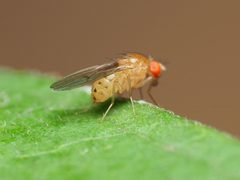
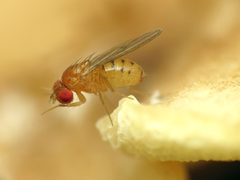
Drosophila falleni is a mycophagous fruit fly native to northeastern North America. It specializes in feeding on the fruiting bodies of diverse fungal . The serves as a for the parasitic Howardula aoronymphium, which manipulates host olfactory . Its was sequenced in 2019 to study immune system evolution.
Pronunciation
How to pronounce Drosophila falleni: /droʊˈsɔfɪlə ˈfælɛnaɪ/
These audio files are automatically generated. While they are not always 100% accurate, they are a good starting point.
Identification
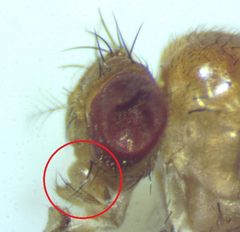
Member of the Drosophila quinaria group. Distinguished from Drosophila melanogaster by narrower olfactory responses tuned specifically to mushroom-derived odorants. Can be separated from closely related D. innubila by geographic distribution and associations.
Images
Habitat
Mushroom environments; associated with fruiting bodies of fungi in forest and woodland settings.
Distribution
Northeastern North America.
Diet
Mycophagous; feeds on fruit bodies (mushrooms) of multiple fungal including Agaricus, Amanita, Agrocybe, Boletus, Cortinarius, Pluteus, Grifola, Polyporus, Hypholoma, Russula, Mycena, Stropharia, and Xerula.
Host Associations
- Howardula aoronymphium - Parasitic that infects fly larvae during mushroom feeding; alters olfactory preferences
Behavior
Attracted to mushroom sites by cueing in on specific odorants common in rotting mushrooms. Exhibits narrower olfactory responses compared to Drosophila melanogaster, consistent with specialized mycophagous . by Howardula aoronymphium alters olfactory preferences: infected flies become more averse to acetate-containing compounds (ethyl acetate, propyl acetate) and more attracted to 1-nonanol.
Ecological Role
Fungivore; contributes to decomposition of fungal fruiting bodies. Serves as for parasitic , supporting nematode completion.
Human Relevance
sequenced in 2019 as part of research on immune system evolution. Studied as a model for - interactions and behavioral manipulation by parasites.
Similar Taxa
- Drosophila innubilaMember of same group (quinaria); distinguished by distribution and ecological associations
- Drosophila melanogaster fruit fly with broader olfactory responses; D. falleni exhibits narrower, mushroom-specific olfactory tuning
- Drosophila suzukii pest of soft fruits with serrated ovipositor; D. falleni is mycophagous, not a crop pest
More Details
Genome sequencing
sequenced in 2019 to investigate evolution of immune systems
Olfactory research significance
Used as model system to study how parasitic alters sensory and foraging decisions
Sources and further reading
- BugGuide
- Wikipedia
- GBIF taxonomy match
- iNaturalist taxon
- NCBI Taxonomy
- Catalogue of Life
- Christine Tabuloc's Seminar: Inside Her Intricate Research World of Drosophila | Bug Squad
- UC Davis Seminars: From Spotted Wing Drosophila to Spider Glue to Wild Bees | Bug Squad
- African Fig Fly Meets Spotted-Wing Drosophila in the U.S.
- Dry, Red Sticky Trap Improves Spotted-Wing Drosophila Monitoring
- New Study Aims to Protect Parasitoids of Spotted-Wing Drosophila
- Spotted-Wing Drosophila: New Seasonal Activity Model Will Aid IPM Efforts
- Olfactory Preferences of the Parasitic Nematode Howardula aoronymphium and its Insect Host Drosophila falleni