
Camillidae
Frey, 1921
Genus Guides
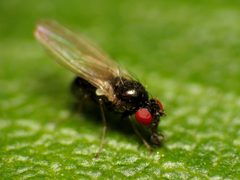
2is a small of minute flies (2–3.5 mm) within the superfamily Ephydroidea. The family contains five , four extant and one fossil. are slender, lustrous black flies with hyaline wings and distinctive bristle patterns on the and . Larval is poorly known, though they have been reared from bat guano and rock hyrax , suggesting a role in decomposing organic matter in sheltered environments.
Pronunciation
How to pronounce Camillidae: //ˈkæmɪlɪˌdiː//
These audio files are automatically generated. While they are not always 100% accurate, they are a good starting point.
Identification
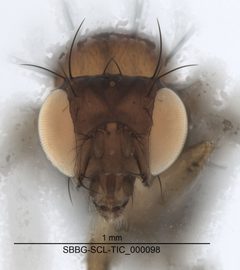
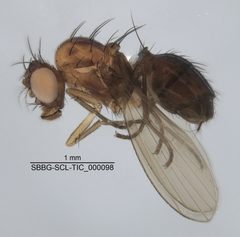
Distinguished from other small Diptera by the combination of: cruciate postvertical bristles; with asymmetric ray length (long above, short below); interrupted near R1; basal and discoidal wing ; and spine on foreleg . The is placed in Ephydroidea based on larval , though characters show some convergent similarities to other small fly families. Identification keys are provided by Papp (1985) for world and Stackelberg (1988) for the Palearctic region.
Images
Appearance
Minute (2–3.5 mm), slender, lustrous black flies with hyaline wings. with cruciate postvertical bristles, three small orbital bristles on each side of (one poorly developed), and well-developed vibrissae. with long rays above and shorter rays below. with two pairs of dorsocentral bristles and one mesopleural bristle. Wing with interrupted near R1, reduced subcosta close to R1, basal and discoidal , and anal cell. Foreleg with a spine.
Habitat
frequent entrances to mammal burrows and nests, and have been observed on flowers. Larval includes dry, decomposed bat guano in caves (documented for Katacamilla cavernicola in Hungary) and rock hyrax in Southern Africa.
Distribution
Recorded from Denmark, Norway, Sweden (GBIF); Hungary (cave localities for K. cavernicola); and Southern Africa (rock hyrax association). The appears to have a disjunct distribution with both Palearctic and Afrotropical elements.
Diet
Larvae have been found in dry, decomposed bat guano and rock hyrax , suggesting detritivory on decaying organic matter. have been observed feeding on flowers.
Life Cycle
Complete with , larva, pupa, and stages. stages were first described for Katacamilla cavernicola; larvae develop in the upper layer of dry, decomposed bat guano rather than fresh guano.
Behavior
Larvae exhibit substrate-specific development in dry, decomposed guano. are associated with mammal burrow entrances and nests, suggesting a behavioral attraction to sheltered, organic-rich environments.
Ecological Role
Decomposer in cave and burrow , processing dry, decomposed guano and . Likely contributes to nutrient cycling in these specialized microhabitats.
Similar Taxa
- DrosophilidaeSimilar small size and wing venation, but Drosophilidae lack the interrupted near R1 and the characteristic with asymmetric ray lengths found in .
- DiastatidaeAlso placed in Ephydroidea with some larval morphological similarities, but differ in bristle patterns and wing configuration; have distinctive foreleg femoral spine and cruciate postverticals.
More Details
Taxonomic history
The was established by Frey in 1921. The first stages were described only in 2001 for Katacamilla cavernicola, making this one of the later dipteran families to have larval documented.
Fossil record
The †Protocamilla Hannig 1965 represents the only fossil genus in the .