
Neurigona
Rondani, 1856
Species Guides
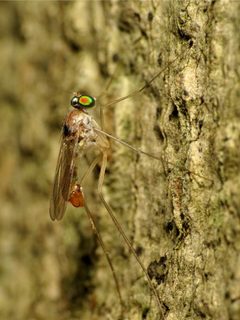
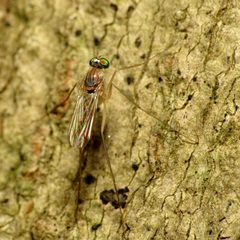
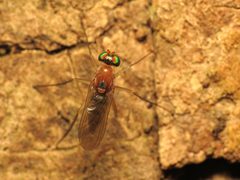
6Neurigona is a large of long-legged flies (Dolichopodidae) comprising over 170 described worldwide. Species are small to medium-sized dolichopodids, typically 4–5 mm in length, with many exhibiting distinctive in leg coloration and structure. The genus has undergone extensive taxonomic revision in recent decades, particularly in Asia, with numerous new species described from China, Russia, and other regions.
Pronunciation
How to pronounce Neurigona: //nʊˈrɪɡɒnə//
These audio files are automatically generated. While they are not always 100% accurate, they are a good starting point.
Images
Habitat
Damp woodland and riparian environments; tree trunks. Specific data available for N. quadrifasciata: damp woods, along streams, and on tree trunks.
Distribution
Widespread across the Palaearctic region, with records from Europe, western Russia east to the Urals, Krasnoyarsk, and Lake Baikal; also present in Britain, Ireland, Scandinavia (Denmark, Norway, Sweden), and East Asia including China (Guangdong, Guizhou, Henan, Jiangsu, Zhejiang, Yunnan provinces), Sakhalin Island (Russian Far East), and Japan.
Seasonality
active mainly May to September (based on N. quadrifasciata records).
Diet
Predatory on small insects; typhlocybine leafhoppers documented as prey for N. quadrifasciata.
Behavior
Males of at least some perform involving modified fore : observed flying in zig-zag patterns up tree trunks, displaying black 3rd–4th fore-tarsomeres contrasted with white 5th segment. Predatory hunting occurs on tree trunks.
Ecological Role
of small insects in woodland and riparian , particularly on tree trunks.
Sources and further reading
- BugGuide
- Wikipedia
- GBIF taxonomy match
- iNaturalist taxon
- NCBI Taxonomy
- Catalogue of Life
- Notes on the Neurigona Rondani (Diptera: Dolichopodidae) from Chinese Mainland
- Two new species of Neurigona Rondani, 1856 (Diptera: Dolichopodidae) from Sakhalin, Russia, with a key to species from the Palaearctic Far East
- The genome sequence of a long-legged fly, Neurigona quadrifasciata (Fabricius, 1781) (Diptera: Dolichopodidae).
- The genus Neurigona Rondani, 1856 (Diptera, Dolichopodidae) from Yunnan, China, with descriptions of seven new species and a key to the species of China.