
Dixidae
Schiner, 1868
Meniscus Midges
Genus Guides
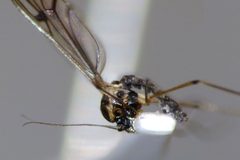
2(meniscus ) are a small of nematocerous Diptera comprising fewer than 200 . are small, frail gnats that remain near aquatic and do not feed. Larvae are aquatic filter-feeders that inhabit unpolluted freshwater margins, where they rest in a distinctive U-shaped posture at the water surface film. The family occurs on all continents except Antarctica and has been documented since the Jurassic period.
Pronunciation
How to pronounce Dixidae: //dɪkˈsɪdi.aɪ//
These audio files are automatically generated. While they are not always 100% accurate, they are a good starting point.
Identification
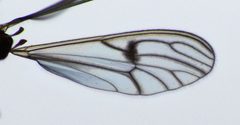
are small (body length ≤5.0 mm), slender gnats with thin legs and black to yellowish-brown coloration. The is relatively broad with 14-segmented and five-segmented palpi. The is short and thick. Wings lack (unlike Culicidae), with subcosta to near base of Rs; wing venation shows R 4-branched, M 2-branched, Cu 2-branched, with strongly arched R 2+3 and distinct r–m crossvein; absent; anal long. Male genitalia inverted 180° by torsion of segments 5–8.
Images
Habitat
Larvae inhabit unpolluted standing or slow-moving fresh waters at margins, just beneath the surface film, typically amongst marginal aquatic vegetation. They occupy hard substrates covered by thin water films (fractions of a millimeter thick), including dead leaves and plant debris at pond edges and watercourse banks. In lotic systems, larvae occur in springs, headwater streams, tufa barriers, and barrage lake outlets.
Distribution
Found on all continents except Antarctica. Palaearctic records include Croatia (six Dixa across 39 sites in Dinaric western Balkan and Pannonian lowland ecoregions), with highest similarity to Italian fauna. Nearctic records include Ozark Mountains and south-central United States. Neotropical records include first documentation from Santa Catarina, Brazil.
Diet
Larvae are filter-feeders that draw in the surface film through their mouthparts and filter organic particles, microorganisms, and decaying plant or animal material for nourishment.
Life Cycle
includes four larval instars and pupa. deposited in masses at water's edge. occurs on emergent substrates. Voltinism varies by : (D. maculata, D. nubilipennis), (D. nebulosa, D. puberula), and multivoltine (D. puberula, D. submaculata).
Behavior
Larvae rest on the water surface in a characteristic reversed U-shaped posture, with surface submerged and non-wettable surface exposed. When dislodged by disturbance, they move along the water surface by flexing their bodies in quick undulating motions. remain close to larval , rest in vegetation, and males of some form swarms.
Ecological Role
Sensitive bioindicators of water quality, particularly responsive to and oil-borne pollutants; larval mortality increases with decreasing surface tension. Significant component of drift in streams. is highest in springs and headwater streams, indicating importance in these as representatives of marginal aquatic fauna.
Similar Taxa
- CulicidaeClosely related distinguished by presence of wing (absent in ) and different larval preferences (open water vs. surface film margins).
- ChaoboridaeRelated nematoceran with aquatic larvae; larvae distinguished by U-shaped resting posture, mid-abdominal , and surface film feeding .
Sources and further reading
- BugGuide
- Wikipedia
- GBIF taxonomy match
- iNaturalist taxon
- NCBI Taxonomy
- Catalogue of Life
- Quelques Dixidae paléarctiques et les habitats de leurs larves [Dipt.]
- Perennial phenology patterns and ecological traits of Dixidae (Insecta, Diptera) in lotic habitats of a barrage lake system
- The genus Dixa (Diptera, Dixidae) in Croatian lotic habitats, with a checklist of species and relationships with the fauna of neighbouring countries
- THREE NEW SPECIES OF DIXELLA DYAR & SHANNON (DIPTERA: DIXIDAE) FROM SANTA CATARINA, BRAZIL
- Rediscovery of Dixa repanda Peters and description of its putative sister species, Dixa falcata sp. nov., from the south-central United States (Diptera: Dixidae)
- The true identity of Dixa modesta Johannsen (Diptera: Dixidae) resolved: <br />synonymy of Dixa similis Johannsen, designation of the Dixa ubiquita species group, and description of three new eastern Nearctic species
- Figure 2 from: Ivković M, Ivanković L (2019) The genus Dixa (Diptera, Dixidae) in Croatian lotic habitats, with a checklist of species and relationships with the fauna of neighbouring countries. ZooKeys 867: 45-54. https://doi.org/10.3897/zookeys.867.36613
- Figure 1 from: Ivković M, Ivanković L (2019) The genus Dixa (Diptera, Dixidae) in Croatian lotic habitats, with a checklist of species and relationships with the fauna of neighbouring countries. ZooKeys 867: 45-54. https://doi.org/10.3897/zookeys.867.36613