
Mycodiplosis
Rübsaamen, 1895
Rust-eating midges
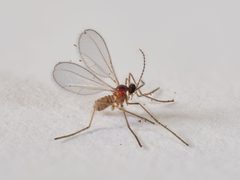
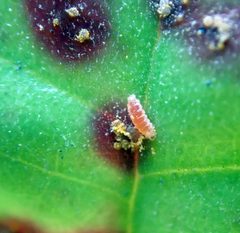
Mycodiplosis is a of gall midges (Cecidomyiidae) whose larvae feed on spores of rust fungi (Pucciniales) and other fungal groups. The genus contains at least 49 described based on male , with phylogenetic analyses suggesting substantial undescribed diversity. Larvae have been detected on 261 rust-infected plant collections across 25 countries, with patterns showing preferential feeding on certain rust species but no strict -specificity at the clade level.
Pronunciation
How to pronounce Mycodiplosis: /ˌmaɪkoʊdɪˈploʊsɪs/
These audio files are automatically generated. While they are not always 100% accurate, they are a good starting point.
Identification
are small, delicate flies typical of gall midges (Cecidomyiidae), with reduced wing venation and long, slender legs. identification relies primarily on adult male ; larvae are found within spore-producing structures (uredinia, aecia) of rust fungi. The can be distinguished from other Cecidomyiidae by association with fungal and larval feeding on spores rather than plant tissue.
Images
Habitat
Associated with rust-infected plants, specifically the spore-producing structures of Pucciniales (rust fungi). Larvae occur on uredinia and aecia of rust fungi infecting diverse plant . availability depends on presence of active rust with accessible spore masses.
Distribution
Recorded from 25 of 44 surveyed countries across multiple continents. One clade has global distribution; 12 clades occur in the United States. GBIF records document presence in Denmark, Norway, and Sweden. Distribution within clades is partially explained by geographic origin.
Seasonality
Larval activity observed from March through June on some rust (e.g., Phragmidium violaceum on Rubus sanguineus, Puccinia menthae on Mentha spicata). On late-season rusts such as Cerotelium fici on Ficus carica, larvae appear at onset and continue until November. Seasonality tracks rust fungal rather than fixed calendar periods.
Diet
Larvae feed on aeciospores and urediniospores of rust fungi (Pucciniales). Second-stage larvae have been observed consuming 82.37% of uredio-pustules in some . Larvae also feed on spores of powdery mildews, downy mildews, Polythrincium trifolii, and Rhytisma acerinum. : feeding habits unknown.
Host Associations
- Rust fungi (Pucciniales) - larval food sourcePrimary ; larvae detected on 261 of 1,350 rust-infected plant collections across 127 rust . Five rust species infested at greater frequency than expected.
- Powdery mildews (Erysiphales) - larval food sourceSecondary group; spores consumed by larvae.
- Downy mildews - larval food sourceSecondary group; spores consumed by larvae.
- Polythrincium trifolii - larval food sourceSpecific fungal documented as larval food.
- Rhytisma acerinum - larval food sourceSpecific fungal documented as larval food.
Life Cycle
Larval stage is the only confirmed feeding stage, consuming fungal spores. Second-stage larvae are particularly voracious. Complete details including placement, sites, and longevity are not documented in available sources.
Behavior
Larvae exhibit preferential feeding on certain rust , though no strict -specificity exists between larval clades and rust hosts at any taxonomic level. frequency varies by plant : 100% occurrence on some families, 92.31% on Fabaceae, absence on Plumbaginaceae. Larval distribution within clades correlates partially with geographic origin.
Ecological Role
Potential agents for rust fungi. By consuming rust spores, larvae may reduce fungal reproductive output and severity. The ecological impact of this on rust has not been quantified.
Human Relevance
Interest as potential agents for agricultural and forest rust . No documented negative impacts on human activities.
Similar Taxa
- Other Cecidomyiidae gall midgesMany gall midge larvae feed on plant tissue or form galls; Mycodiplosis is distinguished by exclusive or primary feeding on fungal spores rather than plant material.
More Details
Species diversity
Currently contains 49 described based on male . Phylogenetic analysis of 206 larval specimens resolved approximately 33 clades (17 with significant support), indicating substantial undescribed diversity.
Taxonomic uncertainty
Some sources refer to 'Mycodiplosis rübsaamen' as a , but this appears to be a misinterpretation of the authority (Rübsaamen, 1895) rather than a valid species epithet.
Sources and further reading
- BugGuide
- Wikipedia
- GBIF taxonomy match
- iNaturalist taxon
- NCBI Taxonomy
- Catalogue of Life
- Survey of Mycodiplosis rübsaamen Larvae Feeding on the Rust Fungi and Their Plant Hosts
- Mycodiplosis (Diptera) infestation of rust fungi is frequent, wide spread and possibly host specific
- A Phylogenetic Analysis of Species Diversity, Specificity, and Distribution of Mycodiplosis on Rust Fungi