
Contarinia
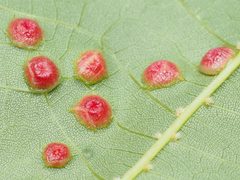
An undescribed species of gall midge in the Contarinia that induces galls on incense cedar (Calocedrus decurrens). As an undescribed species, it lacks formal scientific description and epithet. It belongs to a large genus of cecidomyiid flies, many of which are specialized gall-formers on conifers and other plants.
Pronunciation
How to pronounce Contarinia: /kɒn.təˈrɪ.niə ˌʌn.dɪˈskraɪbd ˈspiː.ʃiːz ɒn ɪnˈsɛns ˈsiːdər/
These audio files are automatically generated. While they are not always 100% accurate, they are a good starting point.
Identification
Distinguished from other Contarinia by its specific association with incense cedar galls. are minute, delicate flies with reduced wing venation characteristic of Cecidomyiidae. Larvae are small, legless, and found within the gall tissue. Formal identification requires examination of larval or adult and comparison with described species; molecular analysis may be necessary given its undescribed status.
Images
Habitat
Associated with incense cedar forests, primarily in montane regions of western North America where Calocedrus decurrens occurs.
Distribution
Western North America, corresponding to the range of its plant incense cedar (Calocedrus decurrens): Sierra Nevada, Cascade Range, and Klamath Mountains of California and Oregon, extending into Nevada and southwestern Oregon.
Diet
Larvae feed on gall tissue induced on incense cedar; feeding habits unknown.
Host Associations
- Calocedrus decurrens - gall inducerIncense cedar; specific plant for gall formation
Behavior
Induces gall formation on incense cedar tissues; specific gall and behavioral details unreported in formal literature.
Ecological Role
As a gall inducer, manipulates plant growth to create protected larval ; potential minor nutrient sink for host plant. Role in unknown.
Human Relevance
No documented economic or medical significance; of potential interest to forest entomologists and gall midge systematists.
Similar Taxa
- Contarinia spp. on other conifersOther Contarinia induce similar galls on related conifer ; differentiation requires host association and morphological examination
- Other Cecidomyiidae on CalocedrusMultiple cecidomyiid may occur on incense cedar; Contarinia distinguished by genus-level morphological characters
More Details
Taxonomic Status
This entity represents an informally recognized but undescribed species. The designation 'undescribed--on-incense-cedar' indicates field recognition by entomologists without formal species description. Publication of formal description would require morphological analysis, potentially including genitalia dissection, larval anatomy, and .
Research Needs
Formal description, characterization of gall , documentation, and molecular phylogenetic placement within Contarinia are needed.