
Anisopodidae
Wood Gnats, Window-Gnats
Subfamily Guides
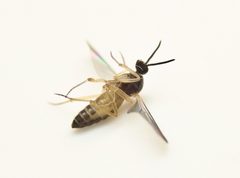
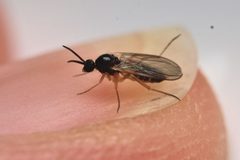
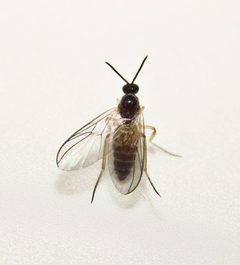
2is a small, of gnat-like flies comprising 154 described extant across 15 , with additional fossil known from the Jurassic through Cenozoic. Commonly called wood gnats or window-gnats, most species are small to medium-sized (4–12 mm), though genera Olbiogaster and Lobogaster are notably larger (17–18 mm) with distinctive spatulated . The family's phylogenetic placement remains controversial, with proposals ranging from sister group to to recognition as multiple distinct families. Some authors recognize four separate families: Anisopodidae, Mycetobiidae, Olbiogastridae, and Valeseguyidae.
Pronunciation
How to pronounce Anisopodidae: //ˌænɪsəˈpɒdɪdiː//
These audio files are automatically generated. While they are not always 100% accurate, they are a good starting point.
Identification
Distinguished from similar nematoceran by combination of: wings held flat over at rest; wide wing with clear anal lobe; specific venation pattern including Rs with two branches arising near wing middle, and characteristic termination of near R4+5 tip; presence of ocelli in equilateral triangle; 14–16 segmented ; and tibial spurs. Dichoptic or and lack of mesonotal transverse further aid separation from Tipulidae and related families. Large spatulated abdomens in Olbiogaster and Lobogaster are diagnostic for those .
Images
Habitat
Associated with woodland and forest environments. Larvae inhabit saproxylic situations (dead and decaying wood), consistent with saprophagous feeding habits. Fossil evidence indicates presence in lacustrine paleolake deposits and nearshore marine environments during Jurassic and Cenozoic periods.
Distribution
distribution. Extant recorded across multiple continents including Europe (France, Germany, Luxembourg, Spain, Baltic States, Russia), Asia (Siberia, China), North America (United States), and South America (Chile). Fossil documented from Jurassic of Eurasia (Luxembourg, Germany, Russia), Eocene (Baltic amber, Oise amber of France, Chinese amber), Oligocene (Luberon, France), and Miocene (Dominican amber).
Diet
Larvae saprophagous (feeding on decaying organic matter). Some fungivorous. diet not documented in available sources.
Life Cycle
Complete with , larval, pupal, and stages. Larvae develop in decaying wood and saproxylic substrates. Specific details on egg deposition sites, , and developmental duration not documented in available sources.
Behavior
often found near windows, hence "window-gnats."
Ecological Role
Larvae contribute to decomposition of dead wood and organic matter in forest . Saprophagous habits link them to nutrient cycling in saproxylic .
Human Relevance
occasionally enter buildings and accumulate on windows. No documented economic or medical significance.
Similar Taxa
- Tipulidae (crane flies)Similar long-legged nematoceran appearance, but distinguished by wings not held flat over , different wing venation including presence of in most , and typically much larger size.
- Bibionidae (March flies)Similar saprophagous larval in some , but have shorter , different wing venation, and more robust body form. Bibionids dominate fossil where anisopodids are rare despite similar .
- Mycetophilidae (fungus gnats)Similar small gnat-like appearance and some shared , but distinguished by different wing venation, typically more humped , and often branched M patterns.
More Details
Taxonomic Controversy
Circumscription of is disputed. Some authors recognize four distinct : Anisopodidae sensu stricto, Mycetobiidae, Olbiogastridae, and Valeseguyidae. Published accounts differ on inclusion of these groups.
Fossil Record
has extensive fossil record extending to Jurassic. Tega demonstrates remarkable wing venation stability throughout Jurassic period. Eocene Baltic amber contains multiple Mycetobia ; Oise amber (France) yielded first European Mesochria record.
Phylogenetic Position
Proposed as sister group to (higher flies), though placement remains unresolved and subject to ongoing research.
Sources and further reading
- BugGuide
- Wikipedia
- GBIF taxonomy match
- iNaturalist taxon
- NCBI Taxonomy
- Catalogue of Life
- A catalog of Anisopodidae (Diptera) from Chile
- The first wood gnat (Diptera: Anisopodidae) from the Oligocene of Luberon (France)
- New Tega (Insecta: Diptera: Anisopodidae) from the Jurassic of Eurasia and the systematic position of Oligophrynidae
- Mycetobia obscura Mamaev, 1968—the first records of Mycetobiinae (Diptera, Anisopodidae) from the Baltic States
- <p><strong>First Mycetobiinae of the lowermost Eocene Oise amber (France) </strong><strong>(Diptera: Anisopodidae)</strong></p>
- Nematocera flies recorded in Serra do Courel, northwest Spain, May 2012 (Diptera: Anisopodidae, Blepharoceridae, Cylindrotomidae, Limoniidae, Pediciidae, Tipulidae and Trichoceridae) including descriptions of two new species of Limoniidae