
Thereva
Latreille, 1796
stiletto flies
Species Guides
10Thereva is a of stiletto flies in the Therevidae. Larvae are predatory, inhabiting sandy soils and loose particulate substrates where they hunt soil-dwelling . are generally drab-colored with a conical . The genus includes with documented on agricultural pest species, though larvae are rather than -specific. Several species have been subject to sequencing to aid identification of the morphologically cryptic larval stage.
Pronunciation
How to pronounce Thereva: //ˈθɛr.ɛ.və//
These audio files are automatically generated. While they are not always 100% accurate, they are a good starting point.
Identification
Larvae cannot be identified to using alone; genomic methods are required. may be distinguished from related by abdominal shape and pattern, though species-level identification requires expert examination. Thereva unica has historically been confused with T. bipunctata.
Images
Appearance
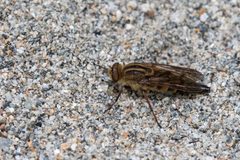
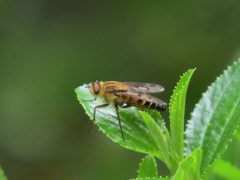
have a conical and drab brown coloration with short . Larvae are long, thin, and featureless with a smooth, dry that enables movement through particulate substrates.
Habitat
Sandy coastal dunes, dry sandy heaths, and other well-drained loose soil . Inland occur on dry sandy heaths in Surrey, the Breckland of East Anglia, and isolated heathlands. Larvae are soil-dwelling in particulate substrates.
Distribution
Europe: widespread in western Europe, common across the UK including coastal areas from Cumbria to Yorkshire, Scotland including the Outer Hebrides, Surrey heaths, and Breckland. Introduced to North America (documented in British Columbia and Vermont).
Diet
Larvae are of soil-dwelling , particularly larvae (including click beetle larvae/wireworms), other hypogeal insect larvae, and earthworms. feeding is unclear.
Life Cycle
Larvae develop in soil or loose particulate substrates. Specific details on , pupal, and longevity are not documented at the level.
Behavior
Larvae 'swim' through sand and loose soil using their smooth, dry , detecting prey by vibrations. Prey is subdued rapidly with venom. In some related , prey captured at the surface is dragged back into the substrate. Males of some species swarm.
Ecological Role
Predatory larvae regulate of soil-dwelling arthropods and worms. Documented on agricultural pest (Agriotes obscurus wireworms) suggests potential as agents, though feeding habits limit suitability for targeted biocontrol.
Human Relevance
Potential agent for soil-dwelling agricultural pests, particularly wireworms. sequencing of multiple supports development of molecular identification tools for the morphologically cryptic larval stage.
Similar Taxa
- Other Therevidae generaThereva share the stiletto fly body plan with conical ; differentiation requires examination of patterns and genitalia.
- Thereva bipunctataHistorically confused with T. unica; genomic identification now distinguishes these .
More Details
Genomic resources
-level assemblies exist for T. nobilitata (829.20 Mb, 6 chromosomal pseudomolecules) and T. unica (910.1 Mb, 6 chromosomal pseudomolecules), achieving Earth BioGenome Project reference standards.
Taxonomic challenges
Larval is insufficient for identification across the , hindering ecological research until molecular methods became available.
Sources and further reading
- BugGuide
- Wikipedia
- GBIF taxonomy match
- iNaturalist taxon
- NCBI Taxonomy
- Catalogue of Life
- Predation of Thereva nobilitata (Fabricius) (Diptera: Therevidae) on Agriotes obscurus L. (Coleoptera: Elateridae)
- The genome sequence of the common stiletto fly, Thereva nobilitata (Fabricius, 1775).
- The genome sequence of a stiletto fly, Thereva unica (Harris, 1780).