
Anaspis
Geoffroy, 1762
false flower beetles
Species Guides
8- Anaspis atrata(Black False Flower Beetle)
- Anaspis collaris
- Anaspis duryi
- Anaspis flavipennis(Yellow-winged False Flower Beetle)
- Anaspis militaris
- Anaspis nigrina
- Anaspis rufa(False Flower Beetle)
- Anaspis sericea
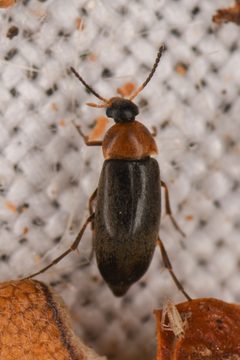
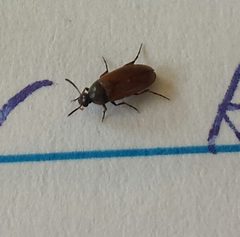
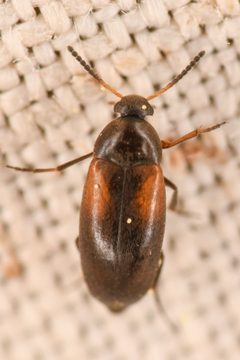
Anaspis is a large of small beetles in the Scraptiidae, commonly known as false flower beetles. are frequently found on flowers, particularly blossoms of trees, shrubs, and umbellifers, and exhibit a characteristic tumbling when disturbed. Larvae are saproxylic, developing in decaying wood of various deciduous and coniferous trees. The genus is widespread across the Palaearctic region, with distributed from Western Europe through Siberia to East Asia.
Pronunciation
How to pronounce Anaspis: /ˈæn.ə.spɪs/
These audio files are automatically generated. While they are not always 100% accurate, they are a good starting point.
Identification
Distinguished from Mordellidae (true tumbling flower beetles) by -level morphological characters; Anaspis lacks the wedge-shaped body and enlarged hind typical of Mordellidae. Within Scraptiidae, identification relies on male genitalia structure, antennomere shape, elytral setae coloration, and body coloration patterns. The is recognized by the combination of small size, flower-associated , and tumbling escape response.
Images
Habitat
Forested and wooded areas. occur on flowering shrubs, trees, and herbaceous plants, particularly blossoms of Rosaceae, Apiaceae, Crataegus, and various umbellifers. Larvae inhabit decaying wood beneath loose bark of deciduous and coniferous trees including Betula, Fagus, Salix, Larix, Quercus, Acer, Alnus, and Ulmus. Some described as stenotopic.
Distribution
Palaearctic distribution: Western and Central Europe eastward through Germany to Italy; trans-Palaearctic extending to western and eastern Siberia, Mongolia, Japan, Republic of Korea, and the Levant. Northern range extends to southern Sweden and Denmark; Mediterranean records from southern France, Corsica, Italy, Sicily, Spain, and Portugal. Northern African records from Algeria. Absent from hot arid steppe zones.
Seasonality
active primarily from April to September, with peak activity varying by latitude. In Britain, adults reported from April–August for most ; northeastern active May–September. Adult typically May–August.
Diet
Larvae: saproxylic feeders on decaying wood, fungi, and wood fibers, acting as general scavengers. : feed on pollen and visit blossoms; anthophilous.
Host Associations
- Betula spp. - larval development
- Fagus sp. - larval development
- Salix sp. - larval development
- Larix spp. - larval development
- Quercus spp. - larval development
- Acer platanoides - larval development
- Alnus glutinosa - larval development
- Ulmus spp. - larval development
- Crataegus spp. - foraging
- Rosaceae - foraging and mating
- Apiaceae - foraging and mating
Life Cycle
Complete . laid in or near decaying wood. Larval development occurs in decaying wood of various tree ; larvae found beneath loose bark. within wood substrate. emerge and disperse to flowers. In Britain, adults active April–September depending on species and location.
Behavior
are , anthophilous (flower-visiting), and readily fly when disturbed. Characteristic tumbling : when disturbed on flowers, individuals fall or tumble to the ground as an escape response. Adults arboricol and floricol, occurring on tree foliage and blossoms. Mating has been observed on flowers.
Ecological Role
Saproxylic larvae contribute to wood decomposition and forest nutrient cycling. serve as flower visitors and likely participate in pollination. Some used as for saproxylic diversity and forest health assessment.
Human Relevance
No significant economic impact. Occasionally encountered by entomologists and naturalists on flowering vegetation. Some used as bioindicators for forest health monitoring. No known agricultural or medical importance.
Similar Taxa
- MordellidaeTrue tumbling flower beetles share flower-associated and tumbling , but differ in having wedge-shaped bodies, enlarged hind for jumping, and different -level .
- Scraptiidae (other genera)Other false flower beetles in the same ; distinguished by antennal , genitalia structure, and subtle body proportions.
Misconceptions
Frequently misidentified as tumbling flower beetles ( Mordellidae) due to similar size, flower , and tumbling escape . The 'false flower beetles' was coined to reflect this resemblance and applies to the family Scraptiidae, though sometimes used specifically for Anaspis.
More Details
Genomic Resources
-level assemblies have been generated for multiple including Anaspis regimbarti (457.61 Mb), A. frontalis, and A. maculata (757.8 Mb) as part of the Darwin Tree of Life project, with high completeness (BUSCO 98.4%) and quality metrics.
Species Diversity
The contains at least 103 described , with A. frontalis (Linnaeus, 1758) as the type species.
Sources and further reading
- BugGuide
- Wikipedia
- iNaturalist taxon
- NCBI Taxonomy
- Catalogue of Life
- The genome sequence of the false flower beetle, Anaspis regimbarti Schilsky, 1895.
- The genome sequence of the false flower beetle, Anaspis frontalis (Linnaeus, 1758).
- The genome sequence of a false flower beetle, Anaspis maculata (Geoffroy in Fourcroy, 1785).