
Litargus
Erichson, 1846
hairy fungus beetles
Species Guides
6- Litargus balteatus(stored grain fungus beetle)
- Litargus connexus
- Litargus grandis(hairy fungus beetle)
- Litargus nebulosus
- Litargus sexpunctatus
- Litargus tetraspilotus(Four-spotted Hairy Fungus Beetle)
Litargus is a of mycophagous beetles in the Mycetophagidae, commonly known as hairy fungus beetles. The genus contains at least 20 described distributed across the Americas and Europe. Members feed on fungal growth, particularly powdery mildews, and are associated with fruit trees and other vegetation. At least one species, L. tetraspilotus, has been studied for its seasonal and potential as a agent.
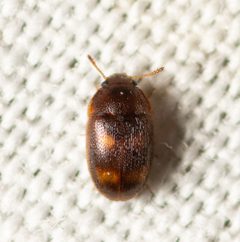
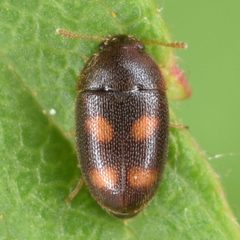
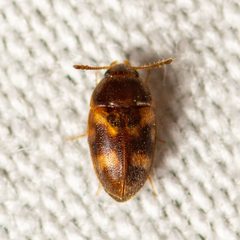
Pronunciation
How to pronounce Litargus: //lɪˈtɑːrɡəs//
These audio files are automatically generated. While they are not always 100% accurate, they are a good starting point.
Images
Habitat
Fruit tree orchards and vegetation supporting fungal growth; specifically documented from citrus plants (Citrus nobilis, C. sinensis, C. limon, C. reticulata), Diospyros kaki, and Prunus persica. Associated with humid conditions that promote powdery mildew development.
Distribution
Americas: Brazil, Mexico, Guatemala, Nicaragua, Panama, Argentina, United States, Canada; Europe: Denmark, Norway, Sweden.
Seasonality
Spring shows greatest abundance; autumn shows lowest abundance. Activity correlates positively with rainfall and relative humidity.
Diet
Mycophagous; feeds on Oidium sp. and other powdery mildew fungi (Erysiphaceae, Ascomycota).
Life Cycle
Laboratory rearing documented at 22.05±1.44°C and 55.68±10.70% RH; laid on fungus-bearing substrate; separate larval and pupal rearing with fungal food source. Specific developmental durations not established from available sources.
Behavior
Seasonal fluctuation driven by humidity and rainfall patterns; shows plant preference, with significantly higher abundance on citrus compared to other fruit trees.
Ecological Role
Mycophagous feeder on plant-pathogenic powdery mildew fungi; potentially regulates fungal on fruit trees in agroecosystems.
Human Relevance
Potential agent for powdery mildew in fruit orchards; poorly studied relative to other mycophagous beetles.