
Tomoxia bucephala
Costa, 1854
Broad-headed Tumbling Beetle
A small in the Mordellidae, commonly known as the Broad-headed Tumbling Beetle. It was first described in the mid-19th century and has since expanded its range from the Palearctic region to North America. Both larvae and feed on wood-decaying fungi, and the overwinters in the larval stage.
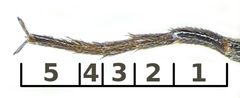
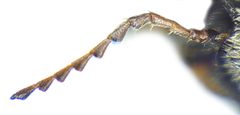
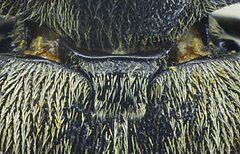
Pronunciation
How to pronounce Tomoxia bucephala: //tɔˈmɔksiə bjuˈsɛfələ//
These audio files are automatically generated. While they are not always 100% accurate, they are a good starting point.
Identification
Members of the Tomoxia can be recognized by their characteristic tumbling : an elongated, wedge-shaped body with a pointed that allows for the 'tumbling' escape typical of Mordellidae. The specific epithet 'bucephala' (meaning 'ox-headed') suggests a broad relative to body size, though precise diagnostic features separating this from require examination.
Images
Habitat
Associated with decaying wood and fungal fruiting bodies in forested and woodland environments.
Distribution
Originally Palearctic; recorded from Belgium, Denmark, Norway, and other European countries. Since 2015, established in North America.
Diet
Wood-decaying fungi, consumed by both larvae and .
Life Cycle
Overwinters as larvae; complete with , larval, pupal, and stages.
Behavior
Exhibits the tumbling escape response characteristic of Mordellidae: when disturbed, the flexes its body and uses its pointed to spring into the air, tumbling unpredictably to evade .
Ecological Role
Decomposer; contributes to nutrient cycling through consumption of wood-decaying fungi.
Human Relevance
No known economic or medical significance; occasionally encountered by mycologists and collectors.
Similar Taxa
- Other Tomoxia speciesMorphologically similar tumbling beetles requiring examination of subtle structural characters for definitive identification.
- Other Mordellidae generaShare the tumbling and general body form, but differ in proportions of , , and antennal structure.
More Details
Range Expansion
The ' detection in North America since 2015 represents a documented range expansion, possibly through human-mediated transport or natural .
Taxonomic History
The was 'redescribed' by Achille in 1854, indicating prior recognition under a different name or description.