
Tetraonyx fulva
LeConte, 1853
Globemallow Blister Beetle
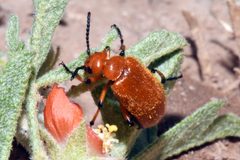
Tetraonyx fulva is a of blister beetle in the Meloidae, first described by LeConte in 1853. It is commonly known as the Globemallow Blister Beetle. The species occurs in North America and is part of the Tetraonycinae, a group characterized by specialized morphological features including tarsal modifications. Like other meloid beetles, it produces , a defensive compound that can cause skin blistering.


Pronunciation
How to pronounce Tetraonyx fulva: /ˈtɛtrəˌɒnɪks ˈfʊlvə/
These audio files are automatically generated. While they are not always 100% accurate, they are a good starting point.
Identification
Tetraonyx fulva can be distinguished from other Tetraonyx by its fulvous (tawny or yellowish-brown) coloration, as indicated by the species epithet. The Tetraonyx is characterized by tarsal modifications, with the name referring to four claws or tarsal structures. Species-level identification within Tetraonyx requires examination of specific morphological characters including body coloration, elytral patterns, and male genitalia. T. fulva is one of approximately 11 described species in the genus, which includes T. quadrimaculata, T. sexguttatus, and T. telephoroides among others.
Images
Habitat
Based on the "Globemallow Blister Beetle," the has been observed associated with globemallow plants (Sphaeralcea spp.). The Tetraonycinae includes species with specialized plant associations.
Distribution
North America. GBIF records confirm presence in this region.
Host Associations
- Sphaeralcea - associated withinferred from "Globemallow Blister Beetle"
Human Relevance
As with other blister beetles, T. fulva produces , a toxic defensive compound that can cause skin blistering upon contact. This chemical defense serves as protection against but can be hazardous to humans handling specimens.
Similar Taxa
- Tetraonyx quadrimaculataSimilar size and body form; distinguished by four distinct maculae (spots) on versus uniform fulvous coloration of T. fulva
- Tetraonyx sexguttatusSimilar ; distinguished by six spotted pattern versus uniform coloration
- Other Epicauta speciesMany Epicauta share similar body form and coloration in Meloidae; distinguished by -level characters including tarsal structure and antennal
More Details
Taxonomic History
The was first described by John Lawrence LeConte in 1853. The Tetraonyx was formerly classified within different tribal arrangements, but current places it in the Tetraonycinae. The specific epithet 'fulva' refers to the tawny or yellowish-brown coloration typical of this species.
Sources and further reading
- BugGuide
- Wikipedia
- GBIF taxonomy match
- iNaturalist taxon
- Meloidae Holdings | Entomology Research Museum
- How Ants Do Battle: Toxic Sprays, Thick Armor, Overwhelming Numbers, and More
- Bug Eric: Two-spotted Cobweb Weaver and kin
- Seeding for Success - Buglife Blog - Buglife
- Gardening for Solitary Bees - Buglife Blog - Buglife
- How One Entomologist Followed a Passion to Understand Insect Interactions