
Lytta chloris
(Fall, 1901)
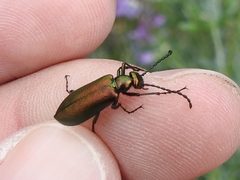
Lytta chloris is a of blister beetle in the Meloidae. It is classified within the subgenus Poreospasta and is known from western North America. Like other members of the Lytta, this species possesses defensive cantharidins in its that can cause skin blistering upon contact. The species was described by Henry Clinton Fall in 1901.
Pronunciation
How to pronounce Lytta chloris: //ˈlɪtə ˈklɔːrɪs//
These audio files are automatically generated. While they are not always 100% accurate, they are a good starting point.
Images
Distribution
North America, with collection records from the western United States including California. The has been documented in museum collections with 19 specimens held at the Entomology Research Museum, University of California, Riverside.
Human Relevance
As a blister beetle, L. chloris likely contains cantharidins and should be handled with caution. Contact with crushed beetles or their can cause skin blistering in humans. The Lytta includes the famous "Spanish fly" (Lytta vesicatoria), though L. chloris is not specifically implicated in human poisonings.
Similar Taxa
- Lytta auriculataAlso placed in subgenus Poreospasta and shares western North American distribution; distinguished by differences in antennal structure and elytral
- Lytta stygicaCommon western Poreospasta with which L. chloris may co-occur; L. stygica is typically larger and more uniformly dark in coloration
- Lytta cyanipennisOverlapping range in western North America; distinguished by blue-green elytral coloration and differences in male genitalia
More Details
Taxonomic Placement
Lytta chloris is placed in the subgenus Poreospasta, a group of primarily western North American Lytta characterized by specific antennal and genitalic features. The was described by H.C. Fall from material collected in California.
Collection History
The Entomology Research Museum at the University of California, Riverside holds 19 specimens of L. chloris as of 2010, indicating it is a moderately rare in collections compared to more common like L. auriculata (785 specimens) or L. stygica (501 specimens).