
Linsleya
MacSwain, 1951
Species Guides
3- Linsleya convexa
- Linsleya sphaericollis(ash blister beetle)
- Linsleya suavissima
Linsleya is a of blister beetles in the Meloidae, established by MacSwain in 1951. The genus comprises approximately five described distributed in North America. As with other meloid beetles, members of this genus possess the characteristic chemical defense of production. The genus is divided into two subgenera: Linsleya (Linsleya) and Linsleya (Linsleyina).
Pronunciation
How to pronounce Linsleya: /lɪnsˈleɪjə/
These audio files are automatically generated. While they are not always 100% accurate, they are a good starting point.
Identification
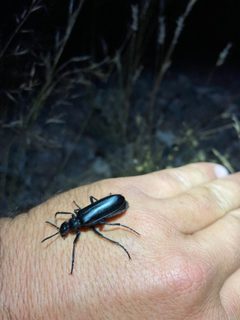
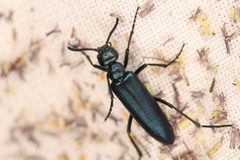
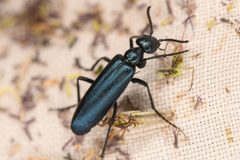
Members of Linsleya can be distinguished from related meloid by genitalic and antennal characters, though specific diagnostic features require examination of . The subgenera are distinguished by subtle morphological differences in and body form. Linsleya convexa has been photographed in the field in Colorado, suggesting activity and association with flowering vegetation.
Images
Habitat
Based on collection records and field observations, occur in shortgrass prairie and canyon environments. Linsleya convexa has been documented in Vogel Canyon, Colorado. The habitat associations suggest to semi-arid grassland and open woodland .
Distribution
North America, with records from the western and central United States including Colorado, Oklahoma, and surrounding regions. The appears to be primarily western in distribution.
Seasonality
activity has been observed during summer months. A field photograph of Linsleya convexa was taken in early summer (June) in Colorado, suggesting peak adult coincides with warm-season flowering vegetation.
Behavior
have been observed on flowers, suggesting feeding on pollen or floral tissues. This is consistent with many meloid beetles that visit flowers for nourishment and mating.
Similar Taxa
- EpicautaBoth belong to tribe Epicautini and share similar body plans and flower-visiting . Epicauta is much more speciose and widespread, with over 150 in North America versus approximately five in Linsleya.
- LyttaAnother meloid with flower-visiting and western North American distribution. Lytta are generally larger and more robust than Linsleya, with different antennal structure.
More Details
Subgeneric classification
The is divided into two subgenera: Linsleya (Linsleya) containing L. convexa and L. suavissima, and Linsleya (Linsleyina) containing L. californica, L. compressicornis, and L. sphaericollis. This subgeneric structure was established by Selander and is reflected in museum collection arrangements.
Museum holdings
The Entomology Research Museum at the University of California, Riverside maintains significant holdings of Linsleya specimens, including 99 specimens of L. sphaericollis, 80 of L. compressicornis compressicornis, 72 of L. californica, over 25 of L. suavissima, and 13 of L. convexa as of 2010.