
Epicauta polingi
Werner, 1944
Poling's Two-toned Blister Beetle
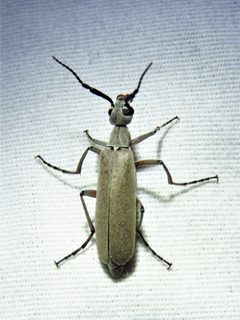
Epicauta polingi is a blister beetle in the Meloidae, first described by Werner in 1944. The is placed in the subgenus Macrobasis, distinguishing it from many other Epicauta species. It is known from both Central America and North America, with museum holdings indicating established in the southwestern United States and Mexico. Like other Epicauta species, it possesses chemical defenses based on .
Pronunciation
How to pronounce Epicauta polingi: /ˌɛpɪˈkaʊtə ˈpoʊlɪnˌɡaɪ/
These audio files are automatically generated. While they are not always 100% accurate, they are a good starting point.
Identification
As a member of the subgenus Macrobasis, E. polingi can be distinguished from the nominate subgenus Epicauta by features of the male genitalia and body proportions typical of that subgenus. Within Macrobasis, identification to requires examination of specific characters established in Werner's original description; the species is one of approximately 50 North American species in this subgenus.
Images
Distribution
Central America and North America. Museum records indicate presence in the southwestern United States (particularly Arizona) and Mexico.
More Details
Taxonomic Placement
The is classified in the subgenus Epicauta (Macrobasis), a diverse group of approximately 50 species in North America characterized by specific morphological features including modified male genitalia.
Museum Holdings
The Entomology Research Museum at the University of California, Riverside holds 93 specimens of E. polingi as of 2010, indicating it is a well-collected with established in the region.