
Notoxus robustus
Casey, 1895
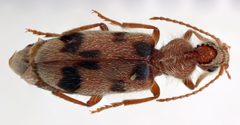
Notoxus robustus is a of -like flower beetle ( Anthicidae) described by Casey in 1895. The Notoxus is characterized by a distinctive forward-projecting snout or rostrum. Records indicate presence in North America, specifically British Columbia, Canada. The species epithet 'robustus' suggests relatively sturdy or substantial build compared to .
Pronunciation
How to pronounce Notoxus robustus: /nɔˈtɒksus roʊˈbʌstəs/
These audio files are automatically generated. While they are not always 100% accurate, they are a good starting point.
Identification
Members of Notoxus are distinguished from other Anthicidae by the pronounced rostrum extending forward from the , with the inserted at its base. N. robustus likely exhibits the typical Notoxus body plan: elongate, somewhat -like form with the head prolonged into a conspicuous snout. Exact diagnostic features separating N. robustus from other Notoxus require examination of specific morphological characters such as pronotal shape, elytral , and rostral proportions.
Images
Distribution
Recorded from North America, specifically British Columbia, Canada.
Similar Taxa
More Details
Taxonomic note
The specific epithet 'robustus' (meaning robust or sturdy in Latin) was applied by Casey in 1895, suggesting this was described as comparatively robust relative to other known Notoxus at that time. The Notoxus currently contains numerous species across multiple continents, with many North American species requiring taxonomic revision.
Data limitations
Only one observation is recorded in iNaturalist, and detailed biological information appears sparse in accessible literature. This is typical for many small, non-pest in the Anthicidae .