
Malporus cinctus
(Say, 1824)
antlike flower beetle
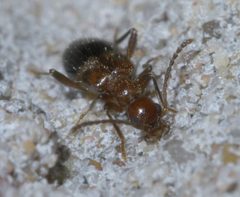
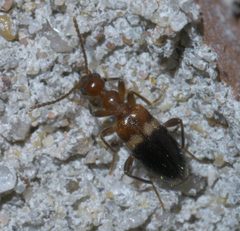
Malporus cinctus is a of antlike flower beetle in the Anthicidae, first described by Thomas Say in 1824. The species is found in North America, with records from Canadian provinces including Manitoba, Ontario, and Saskatchewan. Antlike flower beetles in this family are generally small, elongated beetles that often exhibit -mimicking and . Very little specific biological information is documented for this particular species.
Pronunciation
How to pronounce Malporus cinctus: /ˈmæl.pɔr.əs ˈsɪŋk.təs/
These audio files are automatically generated. While they are not always 100% accurate, they are a good starting point.
Identification
Distinguished from other Anthicidae by combination of size, body proportions, and likely banded coloration. Separation from congeneric requires examination of subtle morphological characters including antennal structure, pronotal shape, and elytral . Antlike flower beetles are distinguished from actual ants by their (hardened forewings) covering the , two pairs of wings, and straight rather than elbowed .
Images
Distribution
North America. Documented from Canadian provinces of Manitoba, Ontario, and Saskatchewan. Distribution in the United States is implied by the North American range but specific states are not recorded in available sources.
Similar Taxa
- Other Malporus speciesCongeneric share antlike flower beetle and require detailed examination for separation.
- Other Anthicidae genera-wide -mimicking body plan creates superficial similarity; genitalic and antennal characters distinguish .
More Details
Taxonomic note
The was originally described by Thomas Say in 1824, a pioneering American entomologist. The Malporus is part of the diverse antlike flower beetle Anthicidae, which contains approximately 3,000 described species worldwide. Members of this family are often found in leaf litter, under bark, or in other decaying organic matter, though specific microhabitat preferences for M. cinctus are not documented.
Sources and further reading
- BugGuide
- Wikipedia
- GBIF taxonomy match
- iNaturalist taxon
- A Good Morning for a Bee | Bug Squad
- Rosie defoliators: Roseslug sawfly, Endelomyia aethiops, Curled rose sawfly, Allantus cinctus, and Bristley rose sawfly, Cladius pectinicornis — Bug of the Week
- Rosie defoliators - Roseslug sawfly, Endelomyia aethiops, Curled rose sawfly, Allantus cinctus, and Cladius pectinicornis — Bug of the Week
- Sawflies - Curled rose sawfly, Allantus cinctus, and dusky birch sawfly, Croesus latitarsus — Bug of the Week
- Archive — Bug of the Week