
Xantholinus
Dejean, 1821
rove beetles
Species Guides
2- Xantholinus linearis(Linear Rove Beetle)
- Xantholinus longiventris(Long-bellied Rove Beetle)
Xantholinus is a of rove beetles (Staphylinidae) comprising approximately 274 , with the majority native to the . The genus has been introduced to North America, where three species (X. elegans, X. linearis, and X. longiventris) are established as . All three North American species are flightless and inhabit open disturbed . Larvae of at least some species are bioluminescent.
Pronunciation
How to pronounce Xantholinus: //zænˈθɒlɪnəs//
These audio files are automatically generated. While they are not always 100% accurate, they are a good starting point.
Identification
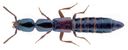
North American can be distinguished by coloration and pronotal features: X. elegans has a black with red-orange pronotum and (bicolored), while X. linearis and X. longiventris are uniformly brown. X. linearis and X. longiventris differ in pronotal microsculpture and moisture preferences. All three species are brachypterous (flightless). Identification of species within the generally requires examination of male genitalia, particularly the armature of the internal sac of the .
Images
Habitat
In North America, occupy open disturbed including agricultural fields (soybean, corn, canola), wooded hedgerows, forest edges, and urban settings. Specimens are found under rocks, in leaf litter, and under . X. longiventris prefers higher moisture conditions such as moss and areas near water, while X. linearis occurs in drier urbanized places. In its native range, X. elegans prefers sandy soils.
Distribution
The is distributed worldwide, with most native to the . In North America, X. elegans has been recorded from Ontario, Canada (2007–2010) and is native to western Europe. X. linearis occurs in eastern North America (Maritime Provinces since 1949, Ontario since 2008, Massachusetts, New Hampshire, Rhode Island) and western North America (Washington since 1930, British Columbia, California, Idaho, Oregon, Nevada, Utah). X. longiventris is restricted to western North America (California, Oregon, Washington). Thirty-eight species are recorded from Turkey.
Seasonality
In the native Palearctic range, the is with appearing in spring and late summer. In North America, adults have been collected throughout summer, with sparse records in spring and fall. One larva collected April 10, 2010 emerged as an adult May 15, 2010.
Diet
Predatory. Larvae have been provided with oribatid mites and early-instar Oniscus asellus in captivity, though direct feeding was not observed.
Life Cycle
in native Palearctic range. Development from larva to can occur in approximately five weeks based on captive rearing (April 10 to May 15).
Behavior
All three North American are brachypterous (flightless). X. elegans and X. linearis are continuing to expand their ranges in North America. The has been introduced to North America via human activity, likely through plant stock importation or associated materials; X. linearis was intercepted in soil with primrose and moss shipments from Europe in the 1930s.
Ecological Role
Predatory beetles that often dominate staphylinid in open disturbed within their native range.
Human Relevance
have been introduced to North America through human-mediated transport, likely via plant stock importation or associated materials. X. linearis was intercepted in soil shipments from Europe in the 1930s. The represents a case study in by flightless insects.
Similar Taxa
- Other StaphylininaeXantholinus can be distinguished from other rove beetle by tribe-level characters and the distinctive color patterns of the North American ; X. elegans in particular is notable for its bicolored appearance (black , red-orange body) compared to uniformly colored relatives.
More Details
Bioluminescence
Larvae of at least some Xantholinus are bioluminescent, a trait of potential ecological significance that has been documented in the .
Flightlessness and dispersal
All three North American Xantholinus are brachypterous (flightless), yet have successfully established and expanded their ranges across North America through human-mediated transport, demonstrating that flightlessness does not preclude long-distance in disturbed .
Sources and further reading
- BugGuide
- Wikipedia
- GBIF taxonomy match
- iNaturalist taxon
- NCBI Taxonomy
- Catalogue of Life
- The adventive genus Xantholinus Dejean (Coleoptera, Staphylinidae, Staphylininae in North America: new records and a synthesis of distributional data
- On the genus Xantholinus Dejean of Turkey: three new species, new and additional records, with distributional checklist (Coleoptera: Staphylinidae: Staphylininae: Xantholinini)
- Figure 6 from: Brunke A, Majka C (2010) The adventive genus Xantholinus Dejean (Coleoptera, Staphylinidae, Staphylininae in North America: new records and a synthesis of distributional data. ZooKeys 65: 51-61. https://doi.org/10.3897/zookeys.65.574
- Figure 2 from: Brunke A, Majka C (2010) The adventive genus Xantholinus Dejean (Coleoptera, Staphylinidae, Staphylininae in North America: new records and a synthesis of distributional data. ZooKeys 65: 51-61. https://doi.org/10.3897/zookeys.65.574
- Figure 1 from: Brunke A, Majka C (2010) The adventive genus Xantholinus Dejean (Coleoptera, Staphylinidae, Staphylininae in North America: new records and a synthesis of distributional data. ZooKeys 65: 51-61. https://doi.org/10.3897/zookeys.65.574
- Figure 5 from: Brunke A, Majka C (2010) The adventive genus Xantholinus Dejean (Coleoptera, Staphylinidae, Staphylininae in North America: new records and a synthesis of distributional data. ZooKeys 65: 51-61. https://doi.org/10.3897/zookeys.65.574
- Figure 7 from: Brunke A, Majka C (2010) The adventive genus Xantholinus Dejean (Coleoptera, Staphylinidae, Staphylininae in North America: new records and a synthesis of distributional data. ZooKeys 65: 51-61. https://doi.org/10.3897/zookeys.65.574
- Figure 4 from: Brunke A, Majka C (2010) The adventive genus Xantholinus Dejean (Coleoptera, Staphylinidae, Staphylininae in North America: new records and a synthesis of distributional data. ZooKeys 65: 51-61. https://doi.org/10.3897/zookeys.65.574
- Figure 3 from: Brunke A, Majka C (2010) The adventive genus Xantholinus Dejean (Coleoptera, Staphylinidae, Staphylininae in North America: new records and a synthesis of distributional data. ZooKeys 65: 51-61. https://doi.org/10.3897/zookeys.65.574