Gyrohypnus angustatus
Stephens, 1833
Narrowed Rove Beetle
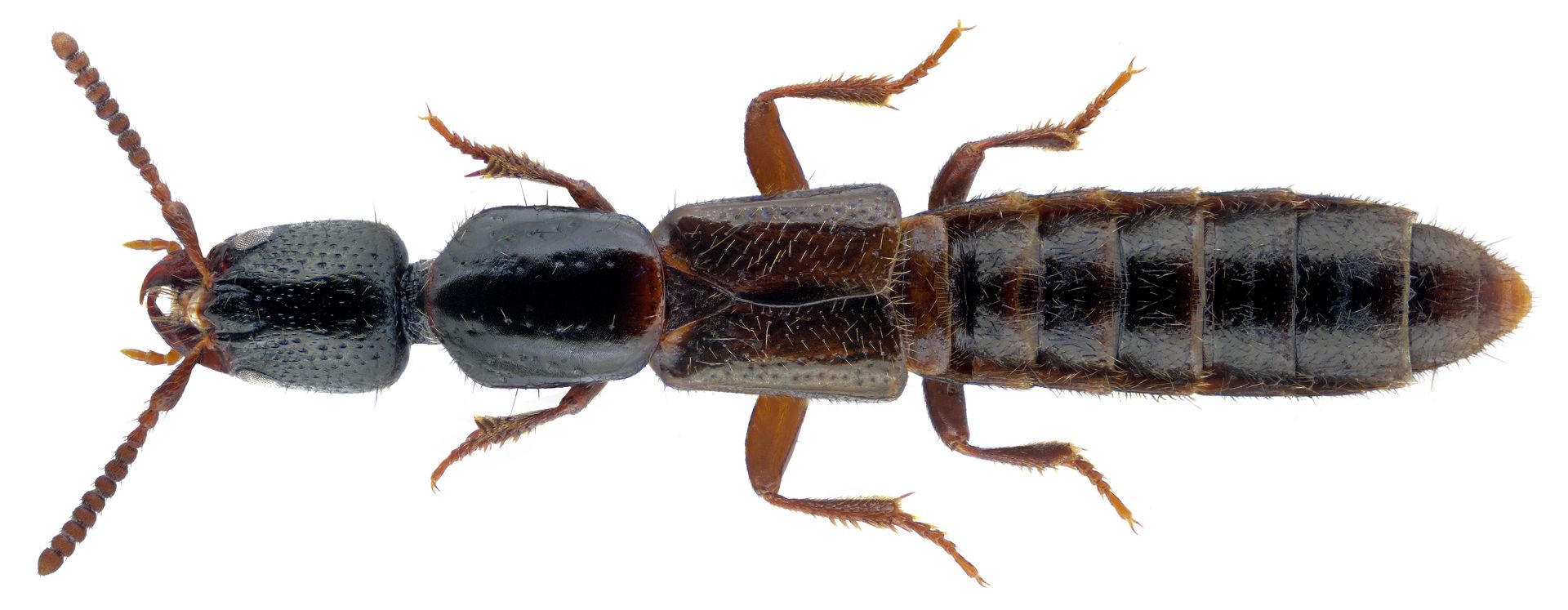
Gyrohypnus angustatus is a rove beetle in the Staphylinidae, tribe Xantholinini. It is native to Europe and parts of Asia and North Africa, and has been introduced to North America. The is associated with decaying organic matter and has been recorded in diverse from Iceland to Central Asia.

Pronunciation
How to pronounce Gyrohypnus angustatus: /ˌdʒaɪ.roʊˈhɪp.nəs ænˈɡʌs.teɪ.təs/
These audio files are automatically generated. While they are not always 100% accurate, they are a good starting point.
Identification
The epithet 'angustatus' (Latin for 'narrowed') likely refers to body shape characteristics. As a member of Gyrohypnus, it shares the -level traits of an elongate body form and the reduced typical of Staphylinidae. Specific diagnostic features distinguishing it from such as G. fracticornis are not documented in available sources.
Images
Habitat
Has been recorded in diverse environments including temperate European woodlands, montane regions in Central Asia, and Mediterranean climates in North Africa. The appears tolerant of cool climates, with records from Iceland and Siberia.
Distribution
Native to the Palearctic: Europe (including Iceland, Madeira), Ukraine, Russia (European and Siberian regions), Armenia, Turkey, Iran, Tajikistan, Kazakhstan, and Morocco. Introduced to North America: Canada (British Columbia, New Brunswick, Newfoundland, Nova Scotia, Ontario, Quebec) and USA (California, New Hampshire, New York, Oregon, Washington).
Ecological Role
As a staphylinid , it likely contributes to nutrient cycling through association with decaying organic matter, though specific ecological functions have not been documented for this .
Human Relevance
No documented economic or medical significance. The North American introduction appears to be rather than intentional.
Similar Taxa
- Gyrohypnus fracticornisCongeneric with overlapping Palearctic distribution; distinguished by subtle differences in antennal and body proportions
More Details
Taxonomic history
Described by James Francis Stephens in 1833, a prominent British entomologist. The Gyrohypnus was established by Leach in 1819.
Introduction to North America
First detected in North America in the mid-20th century; now established across both eastern and western Canada and USA, suggesting multiple introduction events or high capability.