
Othius punctulatus
(Goeze, 1777)
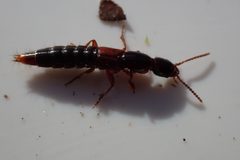
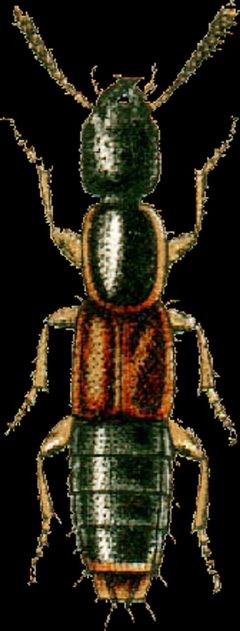
Othius punctulatus is a rove beetle in the Staphylinidae, characterized by short that expose most of the , red elytra that distinguish it from other UK Othius , and lacking a terminal club. It is a predatory species with a native range across the Western Palearctic, including widespread distribution across the British Isles. The species has been introduced to the Pacific Northwest of North America, with first records from Washington in 2011. A sequence of 870.5 megabases has been published, scaffolded into 10 chromosomal pseudomolecules.
Pronunciation
How to pronounce Othius punctulatus: //ˈoʊ.θi.əs pʌŋkˈtʃuː.lɑː.təs//
These audio files are automatically generated. While they are not always 100% accurate, they are a good starting point.
Identification
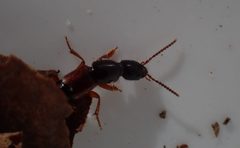
The red immediately distinguish O. punctulatus from other Othius in the UK, which have darker or differently colored elytra. The evenly curved pronotal side margin at the front angle and the extended series of pronotal punctures are additional diagnostic features. The lack a terminal club and are positioned in front of the . In the Pacific Northwest introduction zone, identification should reference the distinctive red elytra and the overall body proportions relative to the smaller O. angustus.
Images
Habitat
Woodland , occurring in both forest interior and edge zones. The shows flexibility in forest habitat use.
Distribution
Native across much of the Western Palearctic including Europe, Russia, North Africa (Morocco, Algeria, Tunisia), Turkey, the Caucasus region (Georgia, Armenia, Azerbaijan), and the Canary Islands. Widespread across the British Isles but less common in the north and west. Introduced to the Pacific Northwest of the United States (Washington), first recorded in 2011 and now established. Possibly introduced to the Canary Islands; records from Kazakhstan and Iran require confirmation.
Seasonality
active throughout the year with peak activity in spring and a secondary peak in late autumn. Most copulation and oviposition occur in autumn.
Diet
Predatory; prey ranges in size from Collembola to other rove beetles. Feeds on larger prey items than its smaller O. angustus.
Life Cycle
found year-round. Most copulation and oviposition occur in autumn. Larvae pupate during the following summer. The reproductive cycle may be flexible. Development from to adult spans multiple seasons with autumn and summer .
Behavior
Peak activity occurs in spring with a secondary peak in late autumn. Predatory targets prey across a size range from small springtails to other rove beetles.
Ecological Role
in woodland , contributing to control of soil-dwelling arthropods including Collembola and other small .
Human Relevance
Subject of sequencing research; established non-native in Washington State, USA, representing a recent introduction to North America. No documented agricultural or economic significance.
Similar Taxa
- Othius angustusSmaller that also occurs in the UK; O. punctulatus distinguished by larger size, red , and feeding on larger prey items
- Other Othius species in UKO. punctulatus uniquely has red among UK ; other species have darker coloration
More Details
Genome resources
A high-quality sequence of 870.5 megabases is available, scaffolded into 10 chromosomal pseudomolecules including the X , with a mitochondrial genome of 20.71 kilobases. BUSCO completeness is 98.8% using the endopterygota_odb10 set. Genome derived from a single female specimen collected in Wytham Woods, Oxfordshire, UK.