
Tanygnathinina
Reitter, 1909
Genus Guides
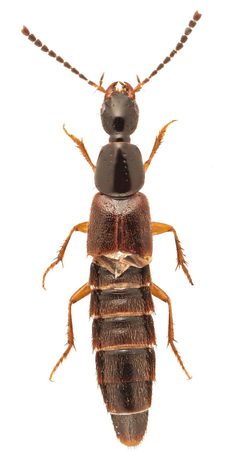
1Tanygnathinina is a subtribe of rove beetles (Staphylinidae: Staphylininae: Staphylinini) established by Reitter in 1909. It has been considered phylogenetically puzzling due to its unclear relationships with the subtribe Quediina. The discovery of the new South African Natalignathus and examination of Atanygnathus larvae has provided evidence linking these two subtribes together, suggesting Tanygnathinina may have evolved from southern Quediina lineages.
Pronunciation
How to pronounce Tanygnathinina: //ˌtæn.ɪɡ.nəˈθɪn.ɪ.nə//
These audio files are automatically generated. While they are not always 100% accurate, they are a good starting point.
Identification
Tanygnathinina can be distinguished from Quediina by various apomorphic states, though the precise diagnostic characters require examination of and larval . The subtribe includes with modified structures and distinctive capsule ridges. Larvae of Atanygnathus possess unique special appendages on the mesothoracic of unknown function—structures unknown elsewhere in Staphylinidae or Coleoptera.
Images
Distribution
The subtribe includes with southern distributions, with Natalignathus being to South Africa. Atanygnathus has been recorded from North America (A. bicolor) and other regions.
Life Cycle
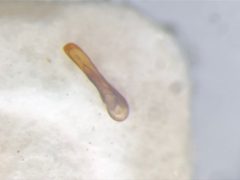
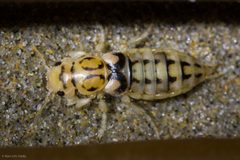
Larvae of Atanygnathus have been described, including detailed for A. bicolor and A. sp. 1. The larval stage possesses distinctive mesothoracic spiracular appendages of unknown function.
Similar Taxa
Misconceptions
Earlier interpretations of Atanygnathus , specifically regarding structure and capsule ridges, were found to be incorrect upon comparative study with Natalignathus.
More Details
Phylogenetic significance
Tanygnathinina represents a critical phylogenetic link between major lineages of Staphylinini. The Natalignathus exhibits a mosaic of plesiomorphic and apomorphic traits, leading to ambiguity regarding whether it should be classified within Tanygnathinina or Quediina.
Larval morphology
Larvae of Atanygnathus possess unique special appendages on the mesothoracic . These structures have no known homologues in any other Staphylinidae or Coleoptera, and their function remains unknown.