
Staphylinina
Latreille, 1802
Genus Guides
8- Creophilus(hairy rove beetle)
- Dinothenarus
- Hadrotes
- Ocypus
- Ontholestes
- Platydracus
- Tasgius(large rove beetles)
- Thinopinus(pictured rove beetle)
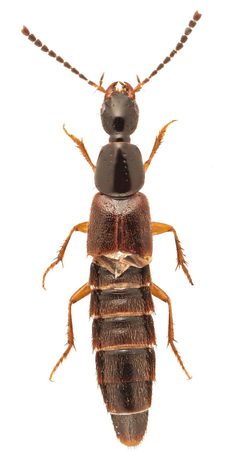
Staphylinina is a subtribe of rove beetles within the tribe Staphylinini, Staphylinidae. Members are typically medium to large-sized rove beetles with elongated bodies and relatively short that leave much of the exposed. The subtribe includes such as Platydracus, Staphylinus, Ocypus, Agelosus, and Naddia. Several have been documented exhibiting specialized including -mimicry and termitophily. The group has a distribution with significant diversity in the Palaearctic and Oriental regions.
Pronunciation
How to pronounce Staphylinina: //ˌstæfəˈlaɪnɪnə//
These audio files are automatically generated. While they are not always 100% accurate, they are a good starting point.
Identification
Members of Staphylinina can be distinguished from other subtribes of Staphylinini by combinations of characters including body size (generally larger than many other rove beetles), antennal structure, and details of the and other genitalic features. Specific identification to requires examination of characters such as the structure of the , pronotum, and male genitalia. The subtribe includes some of the largest rove beetles in North America, such as of Platydracus, which can exceed 20 mm in length.
Images
Habitat
vary by and . Members occur in diverse environments including leaf litter, decaying wood, forest floors, wetlands, and settings. Some species are associated with colonies (termitophily), such as Platydracus juang with Reticulitermes leptomandibularis. Others are found under stones, boards, and in moist microhabitats in disturbed areas.
Distribution
. Documented from North America (including first records in Colorado for introduced such as Tasgius winkleri), Europe, Asia (China, Japan, Nepal, Taiwan, India), and other regions. The subtribe is particularly diverse in the Palaearctic and Oriental regions.
Host Associations
- Reticulitermes leptomandibularis - termitophilyAssociation with Platydracus juang, representing the first documented case of termitophily in the subtribe Staphylinina
Life Cycle
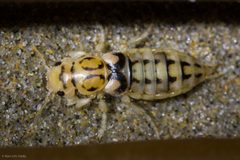
Complete with , larva, pupa, and stages. Larvae of some (e.g., Platydracus, Staphylinus) have been described; Staphylinus erythropterus has been reported to have two larval instars, a state unique within the tribe Staphylinini.
Behavior
Several exhibit specialized . -mimicry (imperfect ) has been observed in Naddia sp., mimicking ants of the Pseudoneoponera. Some species are and associated with human-disturbed . Males of some species have dilated front .
Ecological Role
Predatory role in soil and litter . As part of the larger Staphylinidae , members likely contribute to regulation of in their . Specific functions vary by and habitat.
Human Relevance
Some introduced (e.g., Tasgius winkleri) have expanded their ranges in North America and are considered . Members are generally beneficial and not considered pests. One species has been reported to secrete defensive substances when confined.
Similar Taxa
- Other subtribes of StaphylininiDifferentiated by combinations of morphological characters including genitalic structures, body proportions, and antennal features; requires detailed examination for definitive identification
- PaederinaeAnother of Staphylinidae with predatory members; distinguished by different mouthpart and other structural features
Sources and further reading
- BugGuide
- iNaturalist taxon
- Catalogue of Life
- Bug Eric: A "New" Beetle in Colorado
- Bug Eric: May 2015
- New records and distributional data on the subtribe Staphylinina (Coleoptera: Staphylinidae) from Portugal
- New distributional records of Staphylinina in Taiwan, including a new species of Miobdelus Sharp (Coleoptera: Staphylinidae: Staphylininae: Staphylinini)
- Review of the genera Agelosus Sharp, 1889, Apostenolinus Bernhauer, 1934 and Apecholinus Bernhauer, 1933 (Coleoptera: Staphylinidae: Staphylinini: Staphylinina)
- Comparative larval morphology of Platydracus and Staphylinus (Staphylinidae: Staphylinini: Staphylinina) with notes on their biology and redescription of the pupa of Staphylinus
- A natural history note on the Pseudoneoponera ant-mimicking behaviour of Naddia sp. (Staphylinidae: Staphylininae: Staphylinini: Staphylinina), from Kalyani University campus, Kalyani, Nadia, West Bengal, India.
- The genus Platydracus Thomson in Hainan, South China (Coleoptera, Staphylinidae, Staphylininae).
- Review of Chinese species of the genus Thoracostrongylus Bernhauer, 1915 (Coleoptera, Staphylinidae, Staphylininae).
- Mouthpart Ecomorphology and Predatory Behaviour in Selected Rove Beetles of the "Staphylinine Group" (Coleoptera: Staphylinidae: Staphylininae, Paederinae).
- A Taxonomic Study on the Genus Naddia from China (Coleoptera, Staphylinidae, Staphylininae) with Descriptions of Two New Species.