
Belonuchus rufipennis
(Fabricius, 1801)
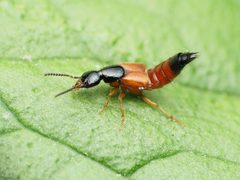
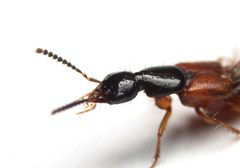
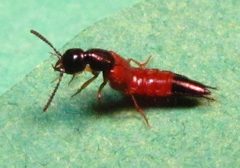
Belonuchus rufipennis is a of rove beetle ( Staphylinidae) first described by Fabricius in 1801. It is considered a relatively large species within the rove beetle family, with documented body lengths ranging from 4.6 to 9 mm. The species exhibits a notably broad geographic distribution spanning the Americas from Canada to Argentina, with additional established in Hawaii and Italy through human introduction.
Pronunciation
How to pronounce Belonuchus rufipennis: /ˌbɛloʊˈnjuːkəs ˌruːfɪˈpɛnɪs/
These audio files are automatically generated. While they are not always 100% accurate, they are a good starting point.
Identification
The combination of relatively large size for a rove beetle (exceeding 4.5 mm), reddish suggested by the specific epithet, and the overall body proportions of the Belonuchus may aid in field recognition. Definitive identification requires examination of genitalic characters and comparison with related in the Philonthina subtribe.
Images
Habitat
Specific associations are not documented in available sources. As a member of Staphylininae, it likely occupies ground-level habitats including leaf litter, decaying organic matter, and other moist microhabitats.
Distribution
Native range: Canada (Ontario, Quebec), United States, Mexico, Guatemala, Belize, El Salvador, Nicaragua, Panama, Colombia, Venezuela, French Guiana, Trinidad, Tobago, Jamaica, Peru, Brazil, and Argentina. Introduced established in Hawaii (USA) and Italy (Galapagos Islands records from Isabela, Santa Cristina, and Santa Cruz).
Human Relevance
The has been introduced to regions outside its native range (Hawaii, Italy), indicating human-mediated , though specific impacts or economic significance are not documented.
Similar Taxa
- Belonuchus speciesCongeneric share the general body plan and require detailed morphological examination for separation; B. rufipennis may be distinguished by size and coloration where these characters are consistent.
- Other Philonthina rove beetlesMembers of this subtribe share similar ecological habits and body forms; identification relies on subtle differences in mouthpart structure, genitalia, and setal patterns.
More Details
Taxonomic note
The was originally described by Johan Christian Fabricius in 1801, placing it among the earlier recognized species of rove beetles. The broad distribution, particularly the disjunct in Hawaii and Italy, suggests either strong capabilities or multiple introduction events through human commerce.