
Ceophyllus monilis
LeConte, J. L., 1849
Ceophyllus monilis is a small rove beetle (Staphylinidae: Pselaphinae) described by LeConte in 1849. The occurs across eastern North America from southern Canada through the eastern and midwestern United States. As a member of the diverse Pselaphinae , it inhabits forest floor litter and soil microhabitats, though detailed ecological studies remain limited.
Pronunciation
How to pronounce Ceophyllus monilis: /siːˈɒfɪləs moʊˈnaɪlɪs/
These audio files are automatically generated. While they are not always 100% accurate, they are a good starting point.
Identification
Identification to level requires examination of male genitalia and other subtle morphological characters typical of Pselaphinae. Distinguished from other Ceophyllus species and related by specific combinations of antennal structure, pronotal and elytral proportions, and aedeagal . Specimens should be compared with type material or verified determinations.
Images
Appearance
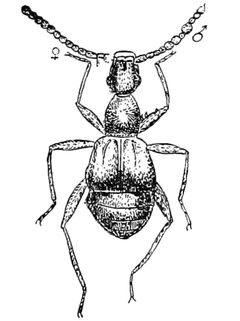
Small-bodied rove beetle with the reduced characteristic of Staphylinidae, exposing most of the elongated . Like other Pselaphinae, it has a compact, somewhat humpbacked body form with relatively short that may have a weakly clubbed or gradually thickened terminal segments. The specific epithet "monilis" (Latin for "necklace" or "chain of beads") may refer to markings or body segmentation pattern, though this interpretation is speculative without direct examination of type material.
Habitat
Forest floor litter and soil microhabitats; specific moisture and substrate preferences not documented.
Distribution
Eastern North America: Canada (Manitoba, Ontario); United States (Alabama, District of Columbia, Delaware, Iowa, Illinois, Indiana, Kentucky, Massachusetts, Maryland, Michigan, Missouri, North Carolina, New Jersey, Ohio, Pennsylvania, Tennessee, Virginia, Wisconsin, West Virginia).
Ecological Role
Member of the soil and litter ; likely contributes to nutrient cycling and preyed upon by larger and small vertebrates.
Similar Taxa
- Other Ceophyllus speciesShare -level characters of body form and antennal structure; require dissection for definitive separation.
- Related Tyrini genera (e.g., Tyrus, Bythinogaster)Overlap in general Pselaphinae ; differ in pronotal shape, antennal club structure, and male genitalia.
More Details
Taxonomic note
The epithet "monilis" has been applied to unrelated in other (e.g., Carabus monilis, the Necklace Ground Beetle, a European carabid), creating potential for confusion. Ceophyllus monilis is a North American pselaphine rove beetle with no close relationship to these other "monilis" species.
Data limitations
Despite being described in 1849, C. monilis remains poorly known biologically. The 15 iNaturalist observations suggest it is rarely encountered or underreported, consistent with the general pattern of neglect for small litter-dwelling beetles.