
Tyrina
Reitter, 1882
Genus Guides
4- Cedius
- Ceophyllus
- Mipseltyrus(ant-loving beetles)
- Tyrus
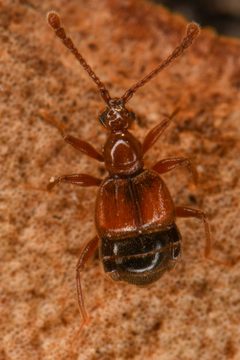
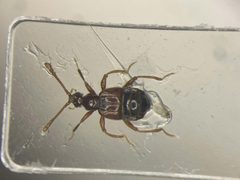
Tyrina is a subtribe of rove beetles ( Staphylinidae) within the Pselaphinae. It was established by Reitter in 1882 and contains approximately 35 described distributed primarily across tropical and subtropical regions, with notable diversity in Asia, Australia, and the Pacific. Members of this subtribe are small, often myrmecophilous beetles that inhabit leaf litter and soil microhabitats. The subtribe is part of the tribe Tyrini, one of the major lineages of the hyperdiverse ant-loving beetle subfamily Pselaphinae.
Pronunciation
How to pronounce Tyrina: /tɪˈriːnə/
These audio files are automatically generated. While they are not always 100% accurate, they are a good starting point.
Identification
Tyrina can be distinguished from other subtribes of Tyrini by the combination of: 11-segmented with a weakly to moderately clubbed apex; pronotum with distinct lateral carinae or foveae; typically shortened, exposing 3-4 abdominal tergites; and complex male genitalia with asymmetrical parameres. The presence of deep antennal cavities on the pronotum (when present) and the structure of the (3-3-3 in most ) are additional diagnostic features. Members are generally small (1.5–4 mm), with compact bodies and often reduced or absent wings.
Images
Habitat
Primarily found in tropical and subtropical forest leaf litter, decaying wood, and soil horizons. Many are associated with colonies (myrmecophily), inhabiting nest refuse chambers or foraging trails. Some occur in montane moss layers and epiphytic accumulations. The subtribe shows highest diversity in humid, structurally complex forest floors with abundant decomposing organic matter.
Distribution
Widespread across the Oriental, Australasian, and Pacific regions, with extensions into the Palearctic (southern China, Japan). Notable centers of diversity include Southeast Asia (Indonesia, Philippines, Vietnam), New Guinea, Australia (especially Queensland), and the Pacific islands (New Caledonia, Fiji, Samoa). Several are to single islands or archipelagos.
Host Associations
- Formicidae - myrmecophilyMany have been observed in nests; specific relationships are documented for some but remain poorly known for most.
Behavior
Strongly associated with ants; many exhibit myrmecophilous including chemical mimicry and integration into colony social structure. Some are known to ride on host ants () during colony emigrations. Activity patterns are poorly documented but likely or given the subterranean and leaf litter .
Ecological Role
Members function as or scavengers in soil and leaf litter , with myrmecophilous potentially contributing to nutrient cycling within nest microhabitats. Their role as in ant colonies may influence colony dynamics, though specific impacts are largely unstudied.
Human Relevance
No direct economic importance. Occasionally collected in ecological surveys and biodiversity assessments. Some are of interest to myrmecologists studying - .
Similar Taxa
- BatraxinaAnother subtribe of Tyrini; distinguished by the presence of a deep, often complex pronotal fovea and different antennal club structure. Tyrina generally lacks the pronounced foveal complexity of Batraxina.
- Pselaphitae (other subtribes)Tyrina can be separated from subtribes in other tribes of Pselaphinae (e.g., Pselaphina, Jubini) by the structure of the mesoventrite, the presence of distinct notosternal , and the configuration of the abdominal defensive gland openings.
More Details
Taxonomic history
The subtribe has undergone significant revision; many were transferred from other subtribes based on male genitalia and mouthpart . The genus-level classification remains unstable, with several recently described genera (e.g., Megatyrus, Taiwanophodes) based on molecular and morphological data.
Conservation status
No have been assessed by the IUCN. Given the high proportion of island endemics and dependence on primary forest , many are likely vulnerable to deforestation and habitat fragmentation.