
Lucifotychus cognatus
(LeConte, 1874)
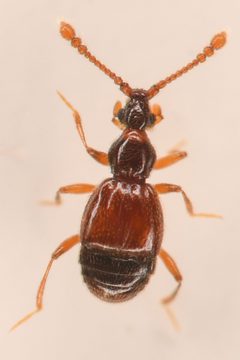
Lucifotychus cognatus is a small rove beetle (Staphylinidae: Pselaphinae) described by John Lawrence LeConte in 1874. Originally described under the Tychus, it was later transferred to Lucifotychus, a genus within the tribe Tychini. The occurs in western North America from Alaska through British Columbia and along the Pacific coast to California. Like other pselaphine rove beetles, it is likely associated with forest floor and decaying organic matter, though specific ecological details remain poorly documented.
Pronunciation
How to pronounce Lucifotychus cognatus: //ˌluːsɪˈfoʊtɪkəs kɔgˈneɪtəs//
These audio files are automatically generated. While they are not always 100% accurate, they are a good starting point.
Identification
Lucifotychus cognatus can be distinguished from other Lucifotychus by genitalic and external morphological features typical of the , including the characteristic body form of Tychini with compact, often -like bodies. The original description by LeConte (1874) under Tychus cognatus provides the primary diagnostic reference. Accurate identification requires examination of microscopic characters and comparison with type material or authoritative redescriptions.
Images
Distribution
Western North America: Alaska, British Columbia, Washington, Oregon, and California. Records suggest a Pacific coastal and montane distribution pattern.
Similar Taxa
- Other Lucifotychus speciesLucifotychus cognatus shares -level characters with ; differentiation requires detailed examination of male genitalia and subtle external features.
- Tychus speciesOriginally described in Tychus; Lucifotychus was established subsequently, and boundaries between related in Tychini require careful study.
More Details
Taxonomic History
First described as Tychus cognatus by LeConte in 1874. The was later transferred to Lucifotychus, a established to accommodate certain Tychini with distinctive morphological features. The basionym Tychus cognatus remains relevant for nomenclatural purposes.
Data Deficiency
Despite being described 150 years ago, L. cognatus remains poorly known biologically. The four iNaturalist observations as of the knowledge cutoff suggest it is infrequently encountered or underreported, possibly due to its small size and cryptic habits typical of Pselaphinae.