
Batrisodes riparius
(Say, 1824)
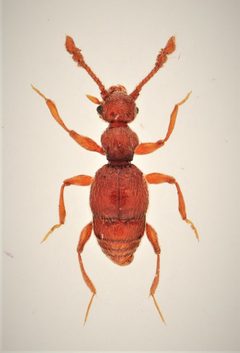
Batrisodes riparius is a small rove beetle in the Pselaphinae, commonly known as short-winged mould beetles. It was described by Thomas Say in 1824, making it one of the earlier described in the . Males of this species, like other Batrisodes, possess distinctive facial modifications including horns, spines, or other projections that give the genus its informal nickname "gargoyle beetles." The species occurs across eastern North America in leaf litter .
Pronunciation
How to pronounce Batrisodes riparius: /ˌbætrɪˈsoʊdiːz rɪˈpeɪriəs/
These audio files are automatically generated. While they are not always 100% accurate, they are a good starting point.
Identification
Positive identification requires examination of male genitalia and facial structures. The is internal and requires dissection to observe. Distinguished from other Batrisodes by specific configurations of male cephalic modifications and aedeagal .
Images
Habitat
Leaf litter in forested environments. Specific microhabitat preferences within leaf litter are unknown.
Distribution
Eastern North America: Canada (New Brunswick, Ontario, Quebec); United States (District of Columbia, Georgia, Illinois, Indiana, Kentucky, Maine, Michigan, Missouri, Mississippi, North Carolina, New Jersey, New York, Ohio, Oklahoma, Pennsylvania, West Virginia).
Diet
of mites and collembola (springtails), based on documented feeding habits of .
Ecological Role
in leaf litter , contributing to regulation of microarthropod .
Similar Taxa
- Batrisodes spretusBatrisodes spretoides was described as resembling B. spretus; B. riparius may also be confused with related eastern requiring genitalia examination for separation.
- Other Batrisodes speciesMany in this are externally similar and can only be reliably distinguished by male genitalia and cephalic structures.
More Details
Taxonomic History
Described by Thomas Say in 1824, making it one of the earliest described in the Batrisodes. The genus currently contains 88 described species in North America.
Identification Challenges
As with many Pselaphinae, -level identification in Batrisodes relies heavily on male genitalia. The is approximately 0.25 mm long and internal, requiring careful dissection of the 2 mm to examine.