
Anotylus
Thomson, C. G., 1859
Species Guides
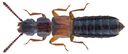
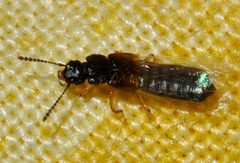
4Anotylus is a of spiny-legged rove beetles (Staphylinidae: Oxytelinae) containing more than 90 described . The genus was established by C.G. Thomson in 1859. At least one species, A. amicus, has been successfully reared in laboratory conditions, exhibiting a period of approximately 26 days at 24°C. Some species groups, such as the gibbulus group, show relictual distributions in the Old World with fossil evidence indicating past range contractions during glacial periods.

Pronunciation
How to pronounce Anotylus: /ˈænəˌtaɪləs/
These audio files are automatically generated. While they are not always 100% accurate, they are a good starting point.
Images
Distribution
Distribution records exist from Denmark (DK), Norway (NO), and Sweden (SE). The gibbulus group has a relictual Old World distribution, with A. gibbulus recorded from the Caucasus region, Eastern Siberia, and as a fossil from Toronto, Canada (c. 120,000 years B.P.) and the British Isles.
Life Cycle
For A. amicus at 24°C: stage averages 4.3 days; three larval instars average 4.0, 4.0, and 7.8 days respectively; averages 1.7 days; pupa averages 4.7 days. Total developmental period from egg to is approximately 26 days under laboratory conditions.
Behavior
A. amicus exhibits mate guarding by males, with associated male-male combat observed in laboratory settings. and larvae use substrate, food, and excrement for nesting. Hindwing length varies within : many individuals possess undeveloped short hindwings, while some individuals—particularly large females—have fully developed long hindwings.
Human Relevance
A. amicus has been proposed as a model organism for studying rove beetle due to its simple rearing requirements, short time, and interesting behavioral and morphological characteristics.
More Details
Sexual dimorphism
In A. amicus, width and body size vary between sexes. Most males are larger than females, though some males are comparable in size to females.
Sources and further reading
- BugGuide
- Wikipedia
- GBIF taxonomy match
- iNaturalist taxon
- NCBI Taxonomy
- Catalogue of Life
- On the gibbulus Group of Anotylus, and fossil occurrences of Anotylus gibbulus (Staphylinidae)
- Establishment of a laboratory‐rearing technique for the rove beetle Anotylus amicus (Coleoptera: Staphylinidae) with investigations of its life cycle, behavior and morphological variations