
Bledius
Leach, 1819
spiny-legged rove beetles
Species Guides
13- Bledius albonotatus
- Bledius analis(spiny-legged rove beetle)
- Bledius annularis(ringed borrow rove beetle)
- Bledius emarginatus
- Bledius fenyesi
- Bledius ferratus
- Bledius gallicus
- Bledius mandibularis(spiny-legged rove beetle)
- Bledius monstratus
Bledius is a of spiny-legged rove beetles in the Staphylinidae, containing at least 100 described . Members of this genus are associated with coastal and riparian , where they have been observed in intertidal zones and along shorelines. The genus was established by Leach in 1819 and is classified within the tribe Blediini of Oxytelinae. Species in this genus exhibit adaptations for life in wet, sandy environments.
Pronunciation
How to pronounce Bledius: /ˈble.di.us/
These audio files are automatically generated. While they are not always 100% accurate, they are a good starting point.
Identification
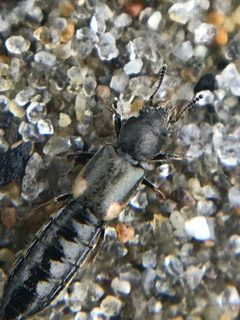
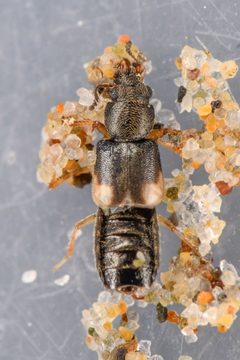
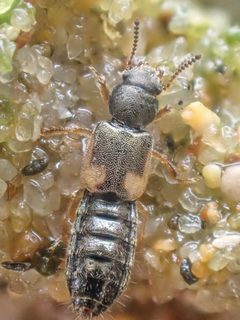
Bledius can be distinguished from other Oxytelinae by the presence of pronounced spines on the legs, particularly the tibiae. Within Staphylinidae, the combination of spiny legs and association with sandy, moist helps separate this genus from morphologically similar rove beetles. Definitive identification requires examination of genitalia and other fine morphological characters.
Images
Appearance
Bledius are small to medium-sized rove beetles with characteristically spiny legs, a trait referenced in their . The body is typically slender and elongated, consistent with the general Staphylinidae form, with short that leave much of the exposed. The legs bear prominent spines that appear adapted for traction in loose substrates. Specific morphological features vary among the 100+ described species.
Habitat
in this are primarily found in moist, sandy environments including coastal shorelines, riverbanks, lake margins, and intertidal zones. They are often associated with substrates subject to periodic inundation or high moisture content. Some species have been documented in saline or brackish coastal .
Distribution
Records exist from Denmark, Norway, and Sweden (GBIF). The has a broad distribution across the Northern Hemisphere, with documented in North America, Europe, and Asia. Many species show regional or restricted ranges.
Behavior
Bledius have been observed burrowing in sand and are active in intertidal zones. Some species are known to construct simple burrows in moist substrates. Activity patterns appear tied to tidal cycles in coastal .
Ecological Role
Predatory or scavenging roles in sandy shoreline ; specific ecological functions vary by and have not been comprehensively documented at the level.
Similar Taxa
- Other Oxytelinae genera (e.g., Oxytelus)Lack the prominent leg spines characteristic of Bledius; often found in different microhabitats such as or decaying matter rather than sandy shorelines.
- Other Staphylinidae with spiny legsDiffer in body proportions, preference, or detailed spine arrangement; Bledius is distinguished by the combination of spiny legs and shoreline habitat association.
More Details
Marine insect association
The is referenced in marine insect literature (Cheng 1976), indicating some ' of saline conditions and intertidal .
Taxonomic diversity
With at least 100 described , Bledius represents a species-rich within Oxytelinae, though many species remain poorly known biologically.