
Empelinae
Newton & Thayer, 1992
Genus Guides
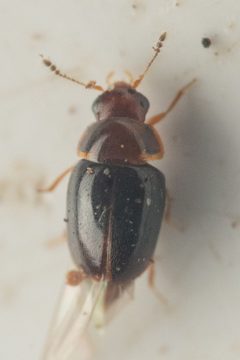
1Empelinae is a small of rove beetles (Staphylinidae) with poorly understood . The subfamily contains a single , Empelus, with only one described , Empelus brunipennis. Members are minute beetles under 2 mm in length, found in secluded microhabitats including forest leaf litter, fungi, and moss along stream edges. Their reclusive has made collection and study difficult, resulting in substantial gaps in knowledge about their and .
Pronunciation
How to pronounce Empelinae: /ɛm.pɛˈliː.naɪ/
These audio files are automatically generated. While they are not always 100% accurate, they are a good starting point.
Identification
Distinguished from other rove beetle by the combination of: minute size (under 2 mm), 11-segmented with loose trisegmented clubs, that nearly completely cover the , and 5-5-5 tarsal formula. The extensive elytral coverage is particularly diagnostic, as most Staphylinidae have short elytra leaving most of the abdomen exposed. Definitive identification requires reference to the Empelus and its sole Empelus brunipennis.
Images
Habitat
Forest leaf litter, fungi, and moss at stream edges. These secluded microhabitats contribute to the difficulty of collecting specimens and the resulting poor state of biological knowledge.
Distribution
North America, ranging from southern Alaska to California. The single described Empelus brunipennis has been described as very successful across this broad geographic range.
Similar Taxa
- AleocharinaeBoth are rove beetle with poorly known due to reclusive habits and association with leaf litter and similar microhabitats. However, Aleocharinae is enormously -rich (thousands of species) with highly variable , while Empelinae is and distinguished by its nearly complete elytral coverage.
- OmaliinaeSome omaliine rove beetles share similar small size and association with damp, decaying organic matter. Omaliinae typically have more abbreviated and different antennal structure.
More Details
Taxonomic status
The was established by Newton & Thayer in 1992. The type Empelus is , containing only Empelus brunipennis (Mannerheim, 1852). This extreme rarity in described diversity may reflect actual biological rarity, extreme specialization, or severe undersampling due to cryptic habits.
Collection challenges
The secluded nature of Empelinae —deep in forest litter, within fungal fruiting bodies, and moss at water margins—makes standard collecting methods ineffective. Specialized techniques such as flotation extraction of litter or careful hand-searching of specific microhabitats are likely required.