
Dasycerus
Brongniart, 1800
Species Guides
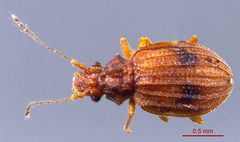
5Dasycerus is the sole extant in the rove beetle Dasycerinae, comprising 25 recognized . Nine cryptic species were recently discovered in 2024, previously attributed to D. carolinensis, distinguishable only by male aedeagal dissection or analysis. The genus exhibits notable intraspecific genetic diversity and cryptic speciation, particularly in montane .
Pronunciation
How to pronounce Dasycerus: /dæˈsɪərəs/
These audio files are automatically generated. While they are not always 100% accurate, they are a good starting point.
Identification
-level identification within Dasycerus often requires male aedeagal dissection or analysis; morphological differentiation between cryptic species is minimal or absent. D. sulcatus and D. elongatus in the Iberian Peninsula can be separated using diagnostic keys based on habitus characters.
Images
Habitat
Forest floor litter, particularly in montane and old-growth forest . D. carolinensis inhabits southern Appalachian mountain forests.
Distribution
Holarctic distribution with in North America (southern Appalachian Mountains) and Europe (Iberian Peninsula). D. carolinensis is to the southern Appalachians with genetically structured across mountain ranges.
Behavior
Flightless; inhabits forest litter. D. carolinensis shows strong phylogeographic structure indicating long-term isolation across river basins and mountain ranges.
Human Relevance
Subject of phylogeographic research demonstrating cryptic diversity and the importance of molecular methods in biodiversity assessment. Old-growth forest associations make it relevant for conservation studies.
Misconceptions
Prior to 2024, multiple cryptic within what was considered D. carolinensis were unrecognized, leading to underestimation of in the .
More Details
Cryptic diversity
A 2024 study revealed nine cryptic previously grouped under D. carolinensis, highlighting that morphological similarity masks substantial genetic divergence. Most interpopulation divergences exceed 5%, indicating deep evolutionary splits dating to ~5.8 million years ago for primary lineages.
Phylogeographic history
D. carolinensis shows a strong primary subdivision across the French Broad River basin dated to approximately 5.8 million years ago, and a secondary western subdivision to ~4.5 million years ago. Old-growth forest fragments do not harbor greater genetic diversity than secondary growth, suggesting population persistence through recent anthropogenic disturbance.
Sources and further reading
- BugGuide
- GBIF taxonomy match
- iNaturalist taxon
- NCBI Taxonomy
- Catalogue of Life
- Intraspecific Diversity and Phylogeography in Southern Appalachian Dasycerus carolinensis (Coleoptera: Staphylinidae: Dasycerinae)
- Contribución al estudio de los Dasycerus Brongniart, 1800 de España (península ibérica) (Coleoptera, Staphylinidae, Dasycerinae)