
Scirtes
Illiger, 1807
marsh beetles
Species Guides
5- Scirtes goliai(marsh beetle)
- Scirtes oblongus(marsh beetle)
- Scirtes orbiculatus(Red-sutured Marsh Beetle)
- Scirtes plagiatus
- Scirtes tibialis(Red-legged Marsh Beetle)
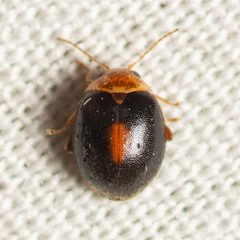
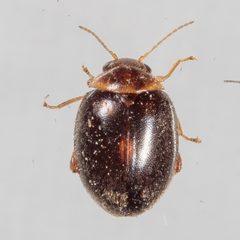
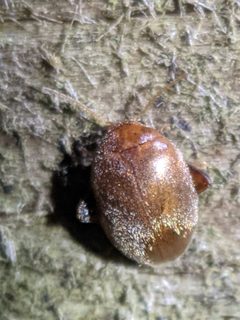
Scirtes is a of marsh beetles ( Scirtidae) comprising more than 80 described . Species are small, often with oblong bodies and variable coloration. Larvae develop in aquatic or semi-aquatic , feeding on and organic matter. are typically short-lived and non-feeding. The genus has a broad distribution spanning North America, Southeast Asia, the Caribbean, and northern Europe.
Pronunciation
How to pronounce Scirtes: /ˈskɜːrtiːz/
These audio files are automatically generated. While they are not always 100% accurate, they are a good starting point.
Identification
Identification to requires examination of genitalia. The laminate is a useful diagnostic feature at the level. Within the genus, species groups such as the flavoguttatus group are distinguished by color patterns and male genitalia .
Images
Habitat
Aquatic and semi-aquatic environments including shallow stagnant pools with abundant , moist substrates near water, and mangrove systems. Larvae are aquatic; occurs in moist soil or debris at water edges.
Distribution
Widespread globally. Documented from North America (Illinois, Florida), Southeast Asia (Malaysia, Indonesia, Vietnam, Philippines, Myanmar, Laos), the Caribbean (Bahamas, Cayman Islands), northern Europe (Denmark), and South America (Colombia).
Seasonality
emerge in late June through July in temperate North American . Tropical likely have extended or year-round activity periods.
Diet
Larvae feed on and organic matter. do not feed.
Life Cycle
Two-year in studied temperate ; larvae overwinter twice. laid in water or on moist substrates. in moist soil or debris near water's edge. are short-lived.
Behavior
attracted to light. Larvae are aquatic and remain in shallow pools.
Ecological Role
Larvae function as and -grazers in aquatic systems, contributing to nutrient cycling in shallow pool and marsh .
Human Relevance
No significant documented economic or medical importance. Of interest to entomologists for taxonomic study and as indicators of aquatic quality.
Similar Taxa
- Other Scirtidae generaSimilar aquatic larval habits; distinguished by prosternal structure and genitalia
More Details
Taxonomic note
placement has varied historically; Scirtes was formerly placed in Helodidae and Dascyllidae, now unified within Scirtidae.
Species diversity
More than 80 described with high diversity in Southeast Asian montane rainforests. The flavoguttatus species-group alone contains 34+ species described from the region since 2015.
Sources and further reading
- BugGuide
- Wikipedia
- GBIF taxonomy match
- iNaturalist taxon
- NCBI Taxonomy
- Catalogue of Life
- Life History of Scirtes Orbiculatus Fabius (Coleoptera: Helodidae)1
- Scirtes Tibialis, Guer., (Coleoptera-Dascyllidæ), with Observations on its Life History.*
- A new species of Scirtes (Coleoptera: Scirtidae) from southern Florida and the Caribbean
- A supplement to the revision of the Scirtes flavoguttatus species-group (Coleoptera: Scirtidae: Scirtinae)