
Coprophanaeus
Olsoufieff, 1924
Species Guides
1Coprophanaeus is a of scarab beetles in the Scarabaeinae, notable for containing some of the largest dung beetles in the Americas. Most are restricted to the Neotropics, with C. pluto being the only species extending into southern Texas. Unlike typical dung beetles, and larvae primarily feed on carrion rather than . The genus is divided into three subgenera: Coprophanaeus, Megaphanaeus, and Metallophanaeus.
Pronunciation
How to pronounce Coprophanaeus: /ˌkɒproʊˈfæniəs/
These audio files are automatically generated. While they are not always 100% accurate, they are a good starting point.
Identification
Distinguished from other Scarabaeinae by the combination of large body size, frequent presence of a cephalic horn, and bright metallic coloration. C. ensifer and C. lancifer are among the largest New World dung beetles and can be confused only with each other or with certain Old World (Catharsius, Heliocopris) not found in the Americas. The primarily carrion-based diet distinguishes them behaviorally from many sympatric -feeding scarabs.
Images
Appearance
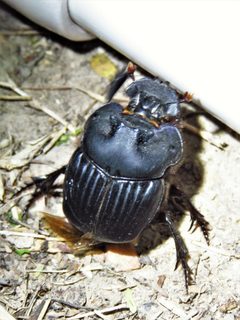
Medium-sized to large beetles. C. ensifer and C. lancifer sometimes exceed 5 cm in length. Often possess a horn on the . Typically bright metallic in color, most commonly blue or green, though red and black also occur.
Habitat
Neotropical terrestrial environments where carrion or sources are available. Specific microhabitat preferences vary by but generally include forested and open with suitable soil for tunneling.
Distribution
Almost entirely Neotropical. Single (C. pluto) ranges into southernmost Texas, USA. Distribution records confirm presence in Colombia (CO) and broadly across the Neotropical region.
Seasonality
or activity pattern. Specific seasonal activity periods vary by and locality but are tied to availability of carrion resources and suitable temperatures for and digging.
Diet
Primarily carrion; many also feed on . and larvae share this feeding habit, which is atypical for Scarabaeinae.
Life Cycle
Paracoprid nesting strategy: dig tunnels into soil beneath food sources, transport food to underground nest chambers, and deposit there. Larvae develop in these chambers feeding on the stored carrion or .
Behavior
Excellent diggers and capable fliers. Active during day or twilight hours. locate carrion resources, excavate tunnels beneath them, and provision nest chambers for offspring.
Ecological Role
Carrion consumers that accelerate decomposition and nutrient cycling. Their feeding places them among the few primarily necrophagous members of the dung beetle Scarabaeinae.
Human Relevance
Of interest to due to predictable of carrion. May provide minimum postmortem interval estimates in forensic investigations. No significant agricultural or economic impacts documented.
Similar Taxa
- PhanaeusSympatric in tribe Phanaeini; distinguished by generally smaller size, different color patterns, and true -feeding
- CatharsiusOld World containing similarly large dung beetles; distinguished by geographic range (Afrotropical/Oriental) and allopatry
- HeliocoprisOld World with comparably large ; distinguished by geographic range and often different horn
More Details
Subgeneric classification
Divided into three subgenera (Coprophanaeus, Megaphanaeus, Metallophanaeus), though monophyly of Coprophanaeus and Metallophanaeus is doubtful
Forensic significance
Carrion-feeding makes predictable colonizers of vertebrate remains, useful for applications