
Deltochilum
Eschscholtz, 1822
Species Guides
2- Deltochilum gibbosum(humpback dung beetle)
- Deltochilum scabriusculum
Deltochilum is a large of dung beetles in the Scarabaeidae, with over 100 described native to the Americas. Most species exhibit typical -feeding , including ball-rolling and burial for larval provisioning. However, the genus contains remarkable exceptions: at least one species, D. valgum, has evolved obligate predatory behavior targeting millipedes, representing a dramatic ecological shift from . This species has undergone corresponding morphological adaptations including a narrow, toothed for decapitating prey and modified hind tibiae for gripping and transporting victims.
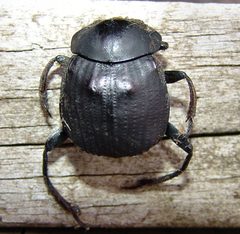
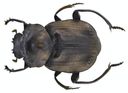
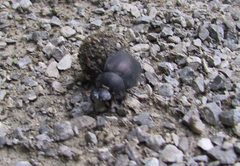
Pronunciation
How to pronounce Deltochilum: /dɛltoʊˈkɪləm/
These audio files are automatically generated. While they are not always 100% accurate, they are a good starting point.
Identification
The is divided into multiple subgenera (Aganhyboma, Deltochilum, Deltohyboma, Calhyboma, among others) with distinguished primarily by male genitalia, clypeal structure, and leg . The subgenus Aganhyboma contains two major species groups: the trisignatum group with typical dung beetle morphology (broad, shovel-shaped), and the valgum group containing predatory species with narrow, elongate heads bearing sharp clypeal teeth. Species in the valgum group also possess elongate, curved hind tibiae and a dorsally reflexed for prey transport. Identification requires examination of and structure; keys are available for Aganhyboma (26 species) and Deltohyboma (47+ species, 165+ undescribed).
Images
Habitat
occupy diverse across the Neotropics including lowland rainforests, montane cloud forests, and desert dune systems. D. valgum occurs in lowland rainforests of Peru. D. burmeisteri and D. mexicanum inhabit well-conserved mountain cloud forests, noted as threatened and fragmented. Some species demonstrate substrate specificity: eucraniine relatives in Argentinian sand dunes suggest potential for similar habitat associations in certain Deltochilum lineages.
Distribution
Native to the Americas, ranging from the Nearctic region (Mexico) through Central America and throughout South America. Records from Puerto López and Parque Nacional Natural Serranía de Chiribiquete in Colombia. The subgenus Aganhyboma is to Central and South America. The subgenus Deltohyboma is exclusively Neotropical.
Diet
Most feed on and utilize it for larval provisioning through ball-rolling and burial . D. valgum is exclusively predatory, killing and consuming millipedes (Diplopoda); ignore all other food sources including dung, carrion, fungus, and fruit. D. gibbosum has been observed associated with wild hog dung. Some species may utilize carrion for larval development.
Life Cycle
Complete with , larva, pupa, and stages. Larvae of D. gibbosum have been described. Larval provisioning typically involves buried balls, though the specific provisioning strategy for predatory like D. valgum remains unobserved; adults consume prey entirely, and whether millipedes are used for larval food is unknown but suspected by researchers.
Behavior
Most exhibit ball-rolling using hind legs to push provisions. D. valgum exhibits unique predatory behavior: are opportunistic hunters that attack injured millipedes preferentially, using sharp clypeal teeth to pierce the surface behind the and pry upward to decapitate the prey. The narrow head facilitates insertion into millipede segments for feeding. Modified hind tibiae grip the prey against a reflexed , allowing the to drag coiled millipedes with one hind leg while forward on the other five legs. No ball-rolling behavior has been observed in this species. occurs nocturnally.
Ecological Role
Most function as processors, contributing to nutrient cycling and soil aeration. D. valgum occupies a novel predatory exploiting chemical defenses (cyanide, benzoquinones) that exclude most competitors; this specialization may have evolved in response to intense competition with 132+ co-occurring dung beetle species in Peruvian rainforests. Predatory species may still contribute to decomposition through millipede carcass processing.
Human Relevance
D. burmeisteri and D. mexicanum proposed as appropriate surrogates for studying effects of modification and climate change due to their restriction to threatened mountain cloud forest . D. gibbosum noted as rarely encountered by collectors, potentially of interest to entomological collectors. No economic importance documented.
Similar Taxa
- EucraniumBoth are large-bodied scarabaeine dung beetles in the Americas with modified legs for food transport; Eucranium carries provisions with enlarged forelegs while on middle and hind legs, whereas Deltochilum typically pushes with hind legs (except predatory that grip prey with hind legs)
- SceliagesAfrican dung beetle containing -predatory ; represents of predatory from ancestry, though Sceliages provisions larvae with crushed millipede balls while D. valgum's larval strategy remains unobserved
- OnthophagusSimilar body size and general dung beetle ; distinguished by different clypeal and genitalic characters, and Onthophagus lacks the extreme predatory adaptations of D. valgum
Misconceptions
The "dung beetle" for D. valgum is misleading given its complete rejection of in favor of ; this has abandoned both dung-feeding and apparently dung-based larval provisioning, representing a fundamental ecological transition rather than mere dietary supplementation.
More Details
Taxonomic Complexity
The is taxonomically complex with eight traditional subgenera. The subgenus Deltohyboma alone contains at least 165 undescribed species. Recent revisions have reorganized subgeneric boundaries, with the former subgenus Deltohyboma now partially merged into Aganhyboma (valgum group). Comprehensive identification requires examination of and detailed genitalic study.
Evolutionary Significance
D. valgum represents one of the few documented complete transitions from to obligate within Scarabaeinae, with associated morphological . The shift has been attributed to resource competition, though the precise selective mechanisms and whether this represents with other (Sceliages, certain phengodid larvae) or retention of primitive predatory traits within the clade remains debated.
Sources and further reading
- BugGuide
- Wikipedia
- GBIF taxonomy match
- iNaturalist taxon
- NCBI Taxonomy
- Catalogue of Life
- Done with dung, meat please! | Beetles In The Bush
- Reduviidae | Beetles In The Bush | Page 3
- Party on a pin oak | Beetles In The Bush
- Fun with eucraniines! My hi | Beetles In The Bush
- A new species and notes on the subgenus Deltochilum (Deltochilum) Eschscholtz, 1822 (Coleoptera: Scarabaeidae: Scarabaeinae: Deltochilini)
- Biology of Deltochilum gibbosum (Fab.) with a Description of the Larva
- A revision of the Deltochilum subgenus Aganhyboma Kolbe, 1893 (Coleoptera: Scarabaeidae: Scarabaeinae)
- Revalidation and redescription of Deltochilum (Calhyboma) burmeisteri (Coleoptera: Scarabaeidae), with a key to related species
- Predatory behaviour inDeltochilum: convergent evolution or a primitive character within a clade?
- Towards a comprehensive taxonomic revision of the Neotropical dung beetle subgenus Deltochilum (Deltohyboma) Lane, 1946 (Coleoptera: Scarabaeidae: Scarabaeinae): Division into species-groups