
Hypotrichia
hypotrichs
Species Guides
1- Hypotrichia spissipes(Florida Hypotrichia)
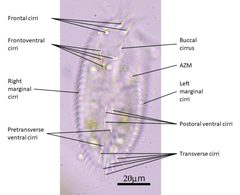
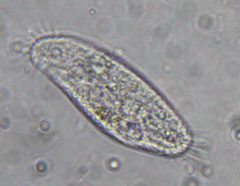
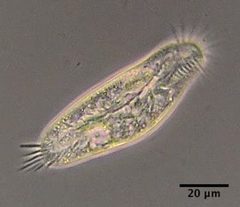
Hypotrichia is a subclass of ciliated protozoa within the class Spirotrichea, characterized by compound ciliary organelles called cirri. These organisms are widespread in freshwater, marine, brackish-water, soil, and moss . They use their cirri to crawl along solid substrates. The group is morphologically diverse, with varying considerably in size, cirral patterns, and nuclear organization. Molecular phylogenetic studies have revealed that several traditionally recognized within Hypotrichia are polyphyletic.
Pronunciation
How to pronounce Hypotrichia: /haɪpoʊˈtrɪkiə/
These audio files are automatically generated. While they are not always 100% accurate, they are a good starting point.
Identification
Hypotrichia can be distinguished from other spirotrich ciliates by the presence of cirri—thick tufts of cilia sparsely distributed on the surface—rather than continuous ciliary rows. Cirri function as coordinated units for substrate crawling. Members typically possess a large oral aperture with an adoral zone of membranelles. The group exhibits considerable morphological diversity in cirral patterns, numbers of transverse and marginal cirri, and arrangement of midventral complexes.
Images
Habitat
Freshwater, marine, brackish-water, soil, and moss . Specific documented habitats include coastal intertidal zones, soil environments, and submerged debris or sediments.
Distribution
distribution with documented occurrences in Southern China (Guangdong), the East China Sea, and multiple geographic regions for brackish-water . GBIF records indicate Nearctic distribution for of same name, which is a separate .
Life Cycle
occurs through binary fission. During , the parental adoral zone of membranelles may be completely renewed in the proter; the oral primordium originates apokinetally in the opisthe; anlagen for marginal rows and kineties develop intrakinetally; and macronuclear nodules typically fuse into a single mass before dividing.
Behavior
Characteristic crawling locomotion using cirri along solid substrates. Exhibits "Slow-Down" behavioral response—a reduction in swimming speed and altered movement patterns—when exposed to sublethal doses of heavy metals such as cadmium, , mercury, nickel, lead, and zinc. This response has been used as a behavioral for toxic stress detection.
Human Relevance
Used as bioindicator organisms for environmental assessment, particularly for heavy metal in aquatic systems. The "Slow-Down" behavioral provides a sensitive method for detecting sublethal toxic stress.
Similar Taxa
- StichotrichiaAnother subclass of Spirotrichea; distinguished by having continuous somatic ciliary rows (stichodyads) rather than discrete cirri
- OligotrichiaSpirotrich subclass with reduced somatic ciliature and typically planktonic lifestyle; lacks the well-developed cirri used for substrate crawling in Hypotrichia
More Details
Taxonomic Confusion
The name "Hypotrichia" has been used for both a subclass of ciliates (Chromista: Ciliophora: Spirotrichea) and a of beetles (Animalia: Arthropoda: Insecta: Coleoptera: Scarabaeidae). These are entirely unrelated . The ciliate subclass Hypotrichia was established by Stein in 1859, while the genus Hypotrichia LeConte, 1861 is a separate nomenclatural entity. The context provided here refers exclusively to the ciliate subclass.
Molecular Phylogenetics
SSU rDNA phylogenetic analyses have revealed that several hypotrich , including Bakuella, are non-monophyletic or polyphyletic, indicating that morphological convergence has confounded traditional classification based on cirral patterns alone.
Sources and further reading
- BugGuide
- GBIF taxonomy match
- iNaturalist taxon
- NCBI Taxonomy
- Catalogue of Life
- Polynucleobacter Bacteria in the Brackish‐Water Species Euplotes harpa (Ciliata Hypotrichia)
- Morphology, Ontogeny and Molecular Phylogeny of a New Urostylid Ciliate, Bakuella (Pseudobakuella) Guangdongica n. sp. (Protista, Ciliophora, Hypotrichia) from Southern China
- Sublethal doses of heavy metals and Slow‐Down pattern ofEuplotes crassus(Ciliophora, Hypotrichia): A behavioural bioassay
- Werewolf, there wolf: variants in Hairless associated with hypotrichia and roaning in the lykoi cat breed
- Morphology and molecular phylogeny of a new ciliate Anteholosticha nanjiensis sp. nov. (Ciliophora, Hypotrichia) collected from the coastal intertidal zone of the East China Sea.