
Ligyrus gibbosus
(De Geer, 1774)
Carrot beetle
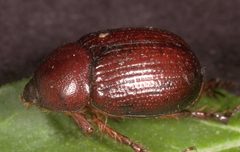
Ligyrus gibbosus, commonly known as the carrot , is a rhinoceros beetle in the Scarabaeidae. measure 13–17 mm and are dark reddish-brown to black. The feeds on roots, grasses, and decaying vegetation in soil, and is recognized as a pest of sunflowers and other crops. Formerly classified under the Tomarus, it was reclassified to Ligyrus in a 2022 taxonomic revision.
Pronunciation
How to pronounce Ligyrus gibbosus: /lɪˈɡaɪrəs ˈdʒɪbəsəs/
These audio files are automatically generated. While they are not always 100% accurate, they are a good starting point.
Identification
can be recognized by their robust, oval body shape typical of rhinoceros beetles, dark reddish-brown to black coloration, and size of 13–17 mm. The lacks the prominent horns seen in some other dynastine beetles. Formerly identified under the Tomarus, specimens may be encountered under that name in older literature.
Images
Appearance
are 13–17 mm (0.5–0.7 in) long, dark reddish-brown to black in color. Larvae are white with a dark .
Habitat
Occurs in agricultural fields and areas with sandy soils. and larvae are found in soil, where they feed on roots and decaying organic matter.
Distribution
Widely distributed across North America. Recorded from Canada (Alberta, Ontario) and throughout the United States (Alabama, Arizona, Arkansas, California, Colorado, Connecticut, Delaware, District of Columbia, Florida, Georgia, Idaho, Illinois, Indiana, Iowa, Kansas, Kentucky, Louisiana, Maine, Maryland, Massachusetts, Michigan, Minnesota, Mississippi, Missouri, Montana, Nebraska, Nevada, New Hampshire, New Jersey, New Mexico, New York, North Carolina, North Dakota, Ohio, Oklahoma, Oregon, Pennsylvania, Rhode Island, South Carolina, South Dakota, Tennessee, Texas, Utah, Virginia, Washington, West Virginia, Wisconsin, Wyoming). Also present in Mexico (Aguascalientes, Baja California, Chihuahua, Coahuila, Distrito Federal, Durango, Guanajuato, Morelos, Nuevo León, San Luis Potosí, Sinaloa, Sonora, Tamaulipas, Zacatecas).
Diet
Feeds on roots, grasses, and decaying vegetation in the soil. Documented as a pest of sunflowers and other crops.
Host Associations
- sunflower - pest feed on roots, causing stunting, wilting, and lodging
Life Cycle
Larvae are white with a dark and develop in soil. Specific details on and time are not documented in available sources.
Behavior
are active in soil where they feed on roots and organic matter. can be detected by excavations near the base of plant stalks made by skunks and other mammals foraging for the beetles.
Ecological Role
Contributes to soil nutrient cycling through consumption of decaying vegetation. Serves as prey for skunks and other soil-foraging mammals.
Human Relevance
Recognized as an agricultural pest, particularly damaging to sunflowers in sandy soils of the Texas Rolling Plains. Control measures include managing pigweed in and around crop fields, as this weed may harbor the pest.
Similar Taxa
- other rhinoceros beetles (Dynastinae)Similar robust body form, but L. gibbosus lacks prominent horns and has distinctive dark reddish-brown to black coloration
- Tomarus (former genus placement)Formerly classified under this ; specimens in older literature or collections may be encountered under this name