
Ochodaeidae
Streubel, 1846
Sand-loving Scarab Beetles
Genus Guides
6is a small of scarab beetles (Coleoptera: Scarabaeoidea) commonly known as sand-loving scarab beetles. The family is distributed globally and contains two : Chaetocanthinae and Ochodaeinae. Members are distinguished by crenulated or serrated mesotibial spurs. The and habits of most remain poorly known, with many collected in sandy areas at night.
Pronunciation
How to pronounce Ochodaeidae: /oʊ.kəˈdeɪ.ɪ.diː/
These audio files are automatically generated. While they are not always 100% accurate, they are a good starting point.
Identification
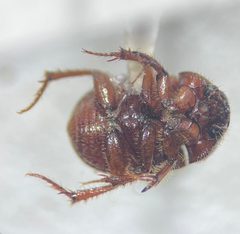
Distinguished from other Scarabaeoidea by the presence of crenulation or serration on at least one mesotibial spur. Within the family, are separated by metatibial spur crenulation (present in Chaetocanthinae, absent in Ochodaeinae), metatibial flattening (present in Chaetocanthinae, absent in Ochodaeinae), and presence of abdominal stridulatory apparatus (absent in Chaetocanthinae, usually present in Ochodaeinae). The Atlantochodaeus is distinguished from Parochodaeus by rounded posterolateral margins, small eye surface, non-prominent gula, widely separated mesocoxae, and slightly prominent elytral apex.
Images
Appearance
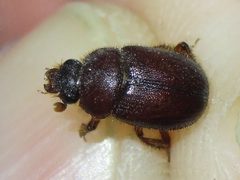
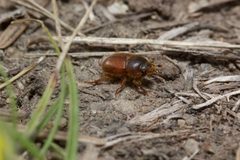
Small beetles, 3–10 mm in length. Body elongate and convex. Coloration ranges from black and brown to yellowish- and reddish-brown shades. terminate in clubs. Legs possess teeth and are adapted for digging. Mesotibial spurs are crenulated or serrated, a diagnostic trait. Metatibia somewhat flattened in Chaetocanthinae, not flattened in Ochodaeinae. of Ochodaeinae usually bears a stridulatory apparatus; Chaetocanthinae lacks this structure.
Habitat
Primarily associated with sandy substrates. Most collected in sandy areas. The Atlantochodaeus occurs in the Brazilian Atlantic Forest. Ochodaeus berytensis has been found in truffle areas in Upper Galilee, Israel. Parochodaeus bituberculatus occurs in Andean regions.
Distribution
Widespread distribution with records from multiple continents: South America (Brazil, Chile, Peru, Argentina), Asia (including Palaearctic Asia), Madagascar, Africa (Namibia), Israel, and other regions. Distribution patterns suggest expansion through Andean Mountain passes in South America.
Seasonality
Most types have been collected at night. Some are active during the day. Activity patterns likely vary by species and region.
Host Associations
- Tuber aestivum - pestOchodaeus berytensis damages cultivated summer truffles in Israel; first recorded association of with hypogeal fungi
Life Cycle
The of Ochodaeus berytensis is believed to occur elsewhere than within truffles, likely at the expense of another unknown hypogeal fungus. Specific details of developmental stages are unknown for most of the .
Behavior
Primarily ; most specimens collected at night using light traps (white light or UV) and interception traps. Some active during the day. Ochodaeus berytensis damages ripe truffle fruiting bodies through borings, tunnels, and galleries.
Ecological Role
Long assumed to be mycophagous based on -level characteristics. Ochodaeus berytensis represents the first confirmed association with hypogeal fungi. Specific functions remain poorly documented for most .
Human Relevance
Ochodaeus berytensis is an agricultural pest in truffle systems in Israel, causing substantial damage to Tuber aestivum fruiting bodies. No other significant human interactions documented.
Similar Taxa
- LeiodidaeLeiodes cinnamomea produces similar damage patterns (borings, tunnels, galleries) in truffles; damage to Tuber aestivum by Ochodaeus berytensis was compared to this leiodid
- Other Scarabaeoidea families shares and digging-adapted legs with other scarab beetles, but is distinguished by crenulated mesotibial spurs
More Details
Taxonomic Structure
contains two : Chaetocanthinae (tribes Chaetocanthini, Pseudochodaeini, Synochodaeini) and Ochodaeinae (tribes Enodognathini, Ochodaeini). Fifteen currently recognized. Atlantochodaeus, described in 2025, represents the first Ochodaeini genus from South America beyond Parochodaeus.
Morphological Features
Ochodaeinae possesses gland, mycangium, and stridulatory apparatus structures. These features have been subject to comparative morphological study, particularly in the context of the Atlantochodaeus description.
Sources and further reading
- BugGuide
- Wikipedia
- GBIF taxonomy match
- iNaturalist taxon
- NCBI Taxonomy
- Catalogue of Life
- Parochodaeus bituberculatus (Erichson) (Coleoptera: Ochodaeidae) and Faargia gentilii (Martínez) (Coleoptera: Scarabaeidae), two species newly discovered in Chile
- Ochodaeus berytensis Petrovitz (Coleoptera: Ochodaeidae), a new pest of the truffle Tuber aestivum in Upper Galilee, Israel
- Atlantochodaeus, A New Genus of Ochodaeidae Streubel, 1846 (Coleoptera, Scarabaeoidea) from Brazilian Atlantic Forest with Four New Species and Morphological Notes to the Family