
Hololepta aequalis
Say, 1825
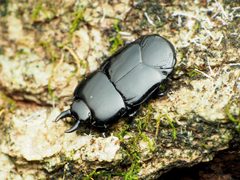
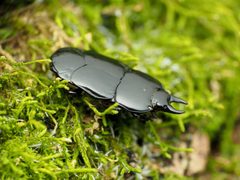
Hololepta aequalis is a flattened histerid found across much of Canada and the eastern United States, occurring at elevations between 525–1,370 meters. It is associated with dead wood of several tree including poplars, pines, willows, and tulip trees (Liriodendron tulipifera). The species is moderately well-documented with over 340 observations, though detailed biological studies remain limited.
Pronunciation
How to pronounce Hololepta aequalis: //hɒləˈlɛptə iːˈkwɑːlɪs//
These audio files are automatically generated. While they are not always 100% accurate, they are a good starting point.
Identification
Distinguished from other Hololepta by the combination of its flattened body, V-shaped antennal annuli, and horizontally projecting palpi. The antennal lobe position under the angles of the prothorax and free are additional diagnostic features. Size range of 8–11.5 mm helps separate it from smaller .
Images
Appearance
Body strongly flattened, measuring 8–11.5 mm in length. Antennal annuli V-shaped. Palpi horizontally projecting in front of the . Antennal lobe positioned under angles of the prothorax. free (not to ).
Habitat
Found in association with dead wood of various deciduous and coniferous trees. Occurs in forested across its range, from lowland to montane elevations (525–1,370 m). Specific microhabitat preferences within these forests are not well documented.
Distribution
Canada: Alberta, British Columbia, Manitoba, Ontario, Quebec, Saskatchewan. United States: eastern states from Maine and New Hampshire south to Florida, west to Texas.
Diet
feed on dead poplars (Populus spp.), pines (Pinus spp.), willows (Salix spp.), and tulip trees (Liriodendron tulipifera). The specific feeding mechanism and whether larvae share these associations are not documented.
Host Associations
- Populus - food sourcedead wood
- Pinus - food sourcedead wood
- Salix - food sourcedead wood
- Liriodendron tulipifera - food sourcedead wood, especially noted
Ecological Role
Member of the saprobic associated with dead wood decomposition. As a histerid , likely predatory or necrophagous in microhabitats under bark or in decaying wood, though specific ecological functions are not documented for this .
Similar Taxa
- Other Hololepta speciesShared characteristics including flattened body form; distinguished by antennal structure, palpi orientation, and body proportions
- Other HisteridaeFlattened body form is widespread in the ; Hololepta distinguished by antennal and mouthpart characters noted above