
Phausis reticulata
(Say, 1825)
Blue Ghost
A firefly in the Lampyridae known for the distinctive blueish-white glow of males observed at night. Males are fully winged and capable of , producing a steady continuous glow rather than flashing patterns typical of many fireflies. Females are wingless, paedomorphic, and retain a larval body form into adulthood. The species exhibits strong in both and bioluminescent display.

Pronunciation
How to pronounce Phausis reticulata: /ˈfaʊsɪs rɛˌtɪkjʊˈlɑːtə/
These audio files are automatically generated. While they are not always 100% accurate, they are a good starting point.
Identification
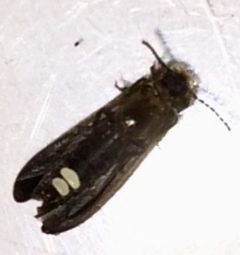
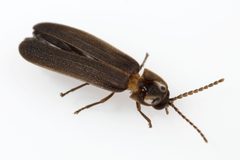
Males can be distinguished from other eastern and central U.S. fireflies by their steady continuous glow rather than -specific flashing patterns. The apparent blueish-white color of male glow at distance (bright green at close range due to Purkinje effect) is distinctive. Females are identifiable by their wingless, yellow, larval appearance with 4–9 glowing spots. Similar Phausis species such as P. inaccensa ('shadow ghost') differ in male lantern presence and geographic distribution.
Images
Appearance
Males are tiny to medium-sized beetles, 6–9 mm in length, with uniformly brown coloration, large , and a short second antennomere relative to the third. They possess fully developed wings and light-producing segments that can be controlled independently to vary glow intensity. Females are wingless, 4–9 mm long, yellow in color, and (paedomorphic), retaining body characteristics throughout adulthood. Both sexes are bioluminescent, though female display is restricted to 4–9 discrete glowing spots.
Habitat
Warm, moist forest areas with spongy leaf litter. occur in both dry and moist woods, near water sources, and along high, dry ridges.
Distribution
Eastern and central United States. Core in the southern Appalachian Mountains and piedmont areas of Georgia, Alabama, South Carolina, North Carolina, and Tennessee. Isolated populations in northern Florida. Documented from Great Smoky Mountains National Park, Chattahoochee National Forest, DuPont State Forest, Pisgah National Forest, and Green River Gamelands in Henderson, Polk, and Transylvania Counties, North Carolina.
Seasonality
Mating activity occurs during warm, moist conditions in forested . Specific seasonal timing not documented in available sources.
Life Cycle
hatch approximately 4–5 weeks after deposition. Larvae are extremely small (1–2 mm) and bioluminescent. Larval development details and not documented. are short-lived; females guard egg clutches for 1–2 weeks until death.
Behavior
Males fly 1–2 feet above ground while emitting steady glow to locate females. Males patrol and hover during mate-searching. Females remain on or near ground, displaying continuous glow from multiple body spots to attract males. Females guard clutches of 20–30 eggs until death. Males are attracted to light traps. Males can independently control each light segment and modulate glow intensity.
Human Relevance
Namesake for Firefly Aerospace's 'Blue Ghost' lunar lander class. Attracts ecotourism to southern Appalachian forests for viewing displays.
Similar Taxa
- Phausis inaccensaAlso called 'shadow ghost'; males lack lanterns entirely (unlike P. reticulata males which glow steadily), and females are but identification requires close examination
- Photinus spp.Most eastern firefly exhibit species-specific flashing patterns rather than continuous glow; males and females both winged in Photinus
Sources and further reading
- BugGuide
- Wikipedia
- GBIF taxonomy match
- iNaturalist taxon
- NCBI Taxonomy
- Catalogue of Life
- Research Sheds Light on Mysteries of the 'Shadow Ghost' Firefly
- Mandarin Boom Means Citrus Pest Management Must Evolve
- Histeridae | Beetles In The Bush
- The perfectly polyphagous Chrysobothris purpureovittata | Beetles In The Bush
- Cloning of the Blue Ghost (Phausis reticulata) Luciferase Reveals a Glowing Source of Green Light
- Courtship and Mating inPhausis reticulata(Coleoptera: Lampyridae): Male Flight Behaviors, Female Glow Displays, and Male Attraction to Light Traps