
Ampedus nigricollis
(Herbst, 1806)
Black-collared Click Beetle
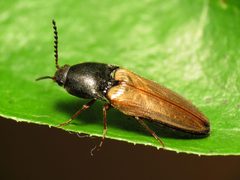
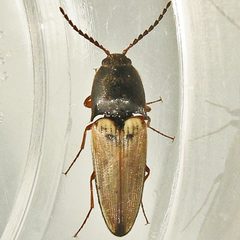
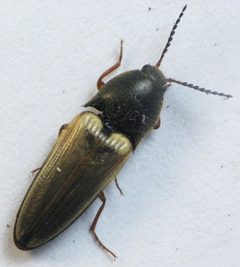
Ampedus nigricollis is a click beetle distinguished by its black pronotal collar contrasting against reddish-orange . It occurs primarily in eastern North America, with substantial observational records from the Canadian Maritimes and Ontario. The species belongs to a whose larvae develop in decaying wood, though specific details for this species remain incompletely documented.
Pronunciation
How to pronounce Ampedus nigricollis: /æmˈpiːdəs ˌnɪɡrɪˈkɒlɪs/
These audio files are automatically generated. While they are not always 100% accurate, they are a good starting point.
Identification
Distinguished from other Ampedus by the sharply defined black portion of the pronotum (the 'collar') against orange-red . Similar species such as Ampedus balteatus and Ampedus sanguinolentus show more extensive dark coloration or different pronotal patterns. The overall body form is elongate with parallel-sided elytra typical of the .
Images
Habitat
Associated with forested environments, particularly where dead and decaying wood is present; larvae require moist, decaying woody substrates for development.
Distribution
Eastern North America: documented from New Brunswick, Nova Scotia, Ontario, and Quebec in Canada; range extends into the northeastern United States based on -level distribution patterns, though specific state records require verification.
Seasonality
active from late spring through summer; peak observations occur May through July based on iNaturalist records.
Behavior
Possesses the characteristic click mechanism of Elateridae: a prosternal spine engages with a mesosternal groove to produce the jumping motion that rights the when overturned.
Ecological Role
Larvae likely contribute to wood decomposition as saproxylic feeders; may visit flowers for pollen or nectar based on observations of congeneric .
Similar Taxa
- Ampedus balteatusLarger dark markings on , lacking the clean collar pattern of A. nigricollis
- Ampedus sanguinolentusMore uniformly red coloration without contrasting black pronotal collar
- Ampedus sanguineusPronotum more uniformly colored, often with darker markings