
Selatosomus pulcher
(LeConte, 1853)
Noble Click Beetle
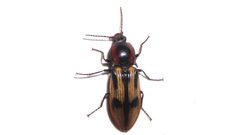
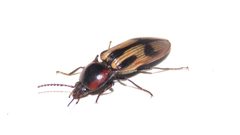
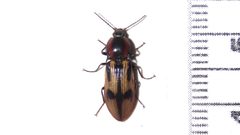
Selatosomus pulcher, commonly known as the Noble Click Beetle, is a of click beetle ( Elateridae) described by LeConte in 1853. The species is found across multiple Canadian provinces including Alberta, British Columbia, Manitoba, New Brunswick, and Nova Scotia. As with other members of the Selatosomus, this species possesses the characteristic clicking mechanism that allows these beetles to right themselves when flipped onto their backs.
Pronunciation
How to pronounce Selatosomus pulcher: /sɛ.laˈto.sɔ.mʊs ˈpʊl.kɛr/
These audio files are automatically generated. While they are not always 100% accurate, they are a good starting point.
Identification
The epithet 'pulcher' (Latin for 'beautiful') suggests distinctive coloration or form, though specific diagnostic features separating this species from are not documented in available sources. Members of Selatosomus are generally recognized by their convex body form and the prosternal process that fits into a mesosternal groove, enabling the characteristic clicking mechanism.
Images
Distribution
Documented from five Canadian provinces: Alberta, British Columbia, Manitoba, New Brunswick, and Nova Scotia. The has been recorded in 383 iNaturalist observations.
Behavior
As a member of the Elateridae, the possesses the 's characteristic clicking mechanism: a prosternal spine that engages with a mesosternal groove to produce a violent snap, propelling the into the air to right itself when overturned.
More Details
Taxonomic Authority
The was described by John Lawrence LeConte in 1853, a prominent American entomologist who described thousands of North American beetles.