
Chauliognathus lewisi vittatus
Lewis' soldier beetle (striped subspecies)
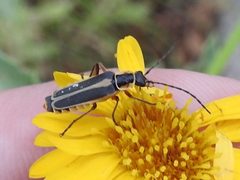
Chauliognathus lewisi vittatus is a of soldier beetle in the Cantharidae. The nominate C. lewisi is distributed in western North America, and the subspecies vittatus appears to represent a striped or banded color morph. Soldier beetles in this are commonly found on flowers where they feed on pollen and nectar, and are known of soft-bodied insects such as aphids. The subspecific epithet "vittatus" refers to the presence of longitudinal stripes or bands on the , distinguishing it from other of C. lewisi.
Pronunciation
How to pronounce Chauliognathus lewisi vittatus: //ˌkaʊ.li.oʊɡˈneɪθəs luˈɪsi vɪˈteɪtəs//
These audio files are automatically generated. While they are not always 100% accurate, they are a good starting point.
Identification
Distinguished from other Chauliognathus lewisi by the presence of distinct longitudinal stripes or vittae on the (the subspecific epithet "vittatus" refers to this striped pattern). The nominate form of C. lewisi typically exhibits more uniform coloration without such striping. As with other soldier beetles, have soft, flexible elytra that do not completely cover the tip, and the body is elongate with thread-like .
Images
Distribution
Western North America; precise range boundaries of the relative to nominate C. lewisi are not well documented in available sources. The C. lewisi occurs in western United States and adjacent Canada.
Diet
feed on pollen and nectar from flowers; also known to prey on soft-bodied insects including aphids and caterpillars. Larvae are predatory on ground-dwelling insects and other small .
Life Cycle
Larvae overwinter in soil, leaf litter, or beneath loose bark. occurs in spring, with emerging to feed on flowers. Multiple may occur depending on climate and locality.
Behavior
are frequently observed on flowers where they feed and mate. Mating in related Chauliognathus involves size-assortative pairing, with larger males having greater mating success. Adults are capable of and are active diurnally.
Ecological Role
serve as while feeding on flowers. Both adults and larvae function as that help regulate of pest insects including aphids, caterpillars, and ground-dwelling .
Human Relevance
Considered beneficial insects in gardens and agricultural settings due to on pest . are harmless to humans and do not bite or sting. Occasionally enter homes in autumn when seeking sites.
Similar Taxa
- Chauliognathus lewisi (nominate form)Lacks the distinct longitudinal elytral stripes characteristic of vittatus; otherwise similar in size, shape, and .
- Chauliognathus pennsylvanicusEastern North American with similar golden-orange coloration and flower-visiting ; distinguished by geographic range and subtle differences in pronotal and elytral markings.
More Details
Taxonomic Note
The vittatus was described based on distinctive striped coloration of the . The validity and geographic extent of this subspecies requires further study, as soldier beetle coloration can be variable.
Fungal Pathogens
Related soldier beetles, including C. pennsylvanicus, are known to be susceptible to the fungus Entomophthora lampyridarum, which causes infected beetles to climb vegetation and clamp on with their before death to facilitate spore . Whether C. l. vittatus is similarly affected has not been documented.