
Alaocybites
E.E. Gilbert, 1956
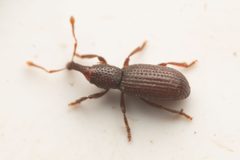
A of small, eyeless or microphthalmic weevils in the Raymondionymidae. Originally described from California with two eyeless , the genus was later discovered in the Russian Far East (Primorsky Kray) and represented by a fossil in Alaska. The genus is characterized by reduced or absent and the absence of tarsomere IV on all legs, traits associated with (soil-dwelling) habits.
Pronunciation
How to pronounce Alaocybites: /ˌæl.i.oʊˈsaɪ.baɪts/
These audio files are automatically generated. While they are not always 100% accurate, they are a good starting point.
Identification
Distinguished from other Raymondionymidae by the combination of eyelessness or extreme microphthalmy and the absence of tarsomere IV. Separated from superficially similar weevils (such as some Otibazo ) by genitalic characters and tarsal structure. The Alaskan fossil species is nearly indistinguishable externally from A. egorovi.
Images
Habitat
environments, specifically leaf litter and soil layers. The reduced indicate to subterranean or deep litter with limited light exposure.
Distribution
Disjunct distribution: California, USA (two eyeless ); Primorsky Kray, Russian Far East (A. egorovi); Alaska, USA (early Late Pliocene fossil record).
Behavior
Presumed to be active in soil and leaf litter layers. The eyeless condition suggests limited or no reliance on vision for navigation or foraging.
Human Relevance
None documented. The is of scientific interest due to its disjunct trans-Pacific distribution and evolutionary significance of eyelessness in weevils.
Similar Taxa
- OtibazoPreviously confused with Alaocybites; the Alaskan fossil was originally assigned to Otibazo before reassignment to Alaocybites based on morphological reanalysis.
- Other RaymondionymidaeShare the absence of tarsomere IV, but differ in structure and geographic distribution.
More Details
Phylogenetic uncertainty
Preliminary phylogenetic analyses have failed to resolve clear affinities of Alaocybites, and its placement in Raymondionymidae remains provisional pending further study.
Fossil record
The early Late Pliocene Alaskan fossil demonstrates remarkable morphological stasis, being nearly identical to the extant Russian Far Eastern A. egorovi.