
Cryptamorpha desjardinsii
(Guérin-Méneville, 1844)
Desjardin's beetle, Desjardin's flat beetle
Cryptamorpha desjardinsii is a small silvanid flat bark beetle, originally described from tropical Asia in 1844. It has established distribution through human-mediated introduction, now occurring across Europe, North America, the Caribbean, and Oceania. The feeds on mildews and moulds, particularly on plants such as flax. Its spread to New Zealand is documented as occurring via Australia.
Pronunciation
How to pronounce Cryptamorpha desjardinsii: /ˌkrɪptəˈmɔːrfə deɪˈʒɑːrˌdɪnziˌaɪ/
These audio files are automatically generated. While they are not always 100% accurate, they are a good starting point.
Identification
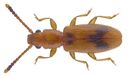
Distinguished from similar silvanid beetles by the regular black markings on the combined with its small size (4–5 mm). Within its expanded range, it may be confused with other Cryptamorpha or small silvanids; examination of elytral pattern and body proportions is necessary for reliable identification.
Images
Appearance
A small measuring 4–5 mm in length. The bear regular black markings.
Habitat
Associated with plants supporting fungal growth, particularly where mildews and moulds occur. In its introduced range, it occupies similar conditions to its native tropical Asian .
Distribution
Native to tropical Asia; now through introduction. Established in Europe, North America, the Caribbean, and Oceania including Australia and New Zealand. Introduced to New Zealand via Australia.
Diet
Feeds on mildews and moulds found on plants. Commonly observed on flax.
Host Associations
- flax - observed oncommonly observed
Human Relevance
Introduced to multiple regions outside its native range, with documented spread to New Zealand via Australia. No documented economic or health significance.
Similar Taxa
- Other Cryptamorpha speciesSimilar size and characteristics; requires examination of elytral markings for separation
- Other small SilvanidaeShared traits of flattened body form and small size; elytral pattern distinguishes C. desjardinsii
More Details
Etymology
Likely named for Julien Desjardins, French zoologist known to the describer Félix Édouard Guérin-Méneville, who became safekeeper of Desjardins' documents after his death.
Taxonomic history
Originally described as Psammoechus desjardinsii in 1844 before transfer to Cryptamorpha.