
Monotoma producta
LeConte, 1855
root-eating beetle
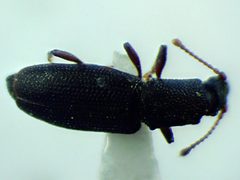
Monotoma producta is a of small in the Monotomidae, commonly referred to as root-eating beetles. The species was described by John Lawrence LeConte in 1855 and is known to occur in North America, with documented records from Canada including New Brunswick, Nova Scotia, and Prince Edward Island. Like other members of Monotomidae, it is associated with decaying plant material and fungal environments. The species remains poorly documented in scientific literature beyond basic taxonomic and distributional records.
Pronunciation
How to pronounce Monotoma producta: //mɒnəˈtoʊmə prɒˈdʌktə//
These audio files are automatically generated. While they are not always 100% accurate, they are a good starting point.
Identification
Specific identification characters for Monotoma producta are not detailed in the provided sources. Accurate identification to level within Monotoma requires examination of subtle morphological characters including antennal club structure, pronotal shape, and male genitalia. The species can be distinguished from other North American Monotoma only through reference to the original description (LeConte 1855) or modern taxonomic revisions of the .
Images
Appearance
Small with the general body plan typical of Monotomidae: compact, somewhat flattened body form with bearing a distinct club. Specific morphological details for M. producta are not well documented in accessible literature. Members of the Monotoma generally exhibit elongate-oval body shape, with the pronotum covering much of the from above, and antennae with a three-segmented club. Coloration and precise body proportions for this require examination of or specialized taxonomic literature.
Habitat
associations are inferred from -level : members of Monotomidae are typically found in decaying plant material, under bark, in rotting wood, and in fungal fruiting bodies. Specific microhabitat preferences for M. producta have not been documented.
Distribution
Documented from North America. Canadian provincial records include New Brunswick, Nova Scotia, and Prince Edward Island. The full extent of its range within North America is not comprehensively mapped.
Ecological Role
As a member of Monotomidae, likely contributes to decomposition processes through association with decaying organic matter and fungi. Specific ecological functions of M. producta have not been studied.
Human Relevance
No documented economic importance or direct interactions with humans. The Monotomidae is not considered significant as agricultural pests or beneficial .
Similar Taxa
- Other Monotoma speciesCongeneric in North America share similar general and associations; require detailed examination of antennal and genitalic characters for separation
- Other Monotomidae genera members such as Rhizophagus share compact body form and antennal clubs; differ in details of pronotal structure and body proportions
More Details
Taxonomic note
The was described by John Lawrence LeConte, a prominent 19th-century American entomologist, in 1855. The specific epithet 'producta' (Latin for 'extended' or 'produced') likely refers to some elongate morphological feature, possibly the pronotum or body form, though the etymology is not explicitly documented in available sources.
Data limitations
This exemplifies the knowledge gap for many small, non-pest beetles. Despite being described nearly 170 years ago, accessible literature contains minimal biological information beyond taxonomic placement and basic distribution. iNaturalist records (9 observations as of source date) suggest it is rarely encountered or underreported by naturalists.