
Psyllobora vigintiduopunctata
(Linnaeus, 1758)
22-spot ladybird, 22-spot lady beetle
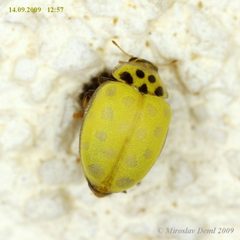
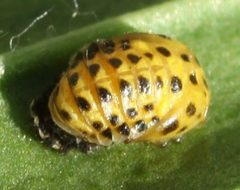
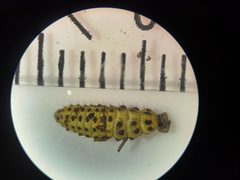
A small European lady beetle, 3–5 mm in length, distinguished by its bright yellow with 22 black spots. It is the only British and Irish ladybird where pupa, larva, and share similar coloration and pattern. Unlike most coccinellids that prey on aphids, this species is a mycophage specializing on powdery mildew fungi. The species was first described in 1758 by Linnaeus and has been recorded in of up to 500 individuals.
Pronunciation
How to pronounce Psyllobora vigintiduopunctata: //ˌsɪloʊˈbɔːrə vɪˌʤɪntiˌduːoʊˈpʌŋkˌteɪtə//
These audio files are automatically generated. While they are not always 100% accurate, they are a good starting point.
Identification
The combination of bright yellow with 22 black spots and yellow/white pronotum with 5 black spots is diagnostic. Distinguished from the similar 20-spotted lady beetle (Psyllobora vigintimaculata) by spot count and slightly more yellowish . The only British/Irish ladybird with pupal and larval stages sharing color pattern. All life stages are conspicuous and relatively easy to identify.
Images
Habitat
Low vegetation in semi-open and maintained areas: meadows, pastures, fields, yards, parks, gardens, forest edges, and open woodlands. Not found higher than 1 meter above ground. Occasionally recorded in woodlands on lower branches of young trees and in coastal areas. Overwinters in leaf litter at bases of birches, hawthorns, and wild apple trees, or under fallen leaves, matted grass tussocks, or moist bark.
Distribution
Native to Europe; recorded from Britain, Ireland, Germany, Netherlands, Slovenia, Belarus, Romania, India (as introduced or vagrant), and Kazakhstan (1000–2000 m elevation).
Seasonality
become very active in April. form in autumn. Some individuals remain active through winter under dock leaves (Rumex) in mild conditions.
Diet
Specialized mycophage feeding on powdery mildew fungi (Erysiphe holosericea and related ), particularly on umbellifers and low-growing shrubs. Preferred plants include cowparsley (Anthriscus sylvestris), ragwort (Senecio jacobaea), and creeping thistle (Cirsium arvense).
Host Associations
- Anthriscus sylvestris - feeds on mildew on this plantpreferred
- Senecio jacobaea - feeds on mildew on this plantpreferred
- Cirsium arvense - feeds on mildew on this plantpreferred
- Astragalus - original discovery type locality in Germany, 1874
- Erysiphe holosericea - food sourcepowdery mildew fungus
- Betula - siteleaf litter at base
- Crataegus - siteleaf litter at base
- Malus - sitewild apple, leaf litter at base
- Rumex - winter shelteractive individuals found under dock leaves in winter
Life Cycle
laid under leaves near plant fungi, 20–100 per female, slightly yellowish and creamy. Hatching after 5 days; larvae do not feed on egg but wait ~3 hours before feeding on mildew. Four larval instars: first instar 22 hours, second instar 4 days, third instar variable, fourth instar 3 days. within 24 hours of attachment to leaf; pupal stage ~6 days. Mating occurs soon after ; males promiscuous. Egg laying begins ~2 weeks after mating.
Behavior
Low-dwelling, rarely found above 1 meter. Can be collected by beating vegetation. Males are promiscuous. Larvae immediately seek mildew food source after hatching rather than consuming . Forms of up to 500 individuals. Some individuals remain active in winter under protective vegetation.
Ecological Role
Specialized biocontrol agent of powdery mildew fungi; fills a distinct from aphidophagous lady beetles. Part of the guild of natural enemies limiting fungal plant in herbaceous vegetation.
Human Relevance
Featured on postage stamps in Jersey (2008), Belarus (2015), Slovenia (2017), India (2017), Netherlands (2018), and Romania (2024). First recorded at Royal Botanic Gardens, Kew in 1969. contains the dimeric alkaloid psylloborine A, of scientific interest for its unique structural features. Namesake of Finnish indie rock band 22-Pistepirkko.
Similar Taxa
- Psyllobora vigintimaculata20-spotted lady beetle; differs by spot count (20 vs. 22), and has paler, more translucent compared to the slightly yellowish eggs of P. vigintiduopunctata
More Details
Chemical defense
Contains psylloborine A, a dimeric alkaloid with unique structural features in the , representing complex chemical defenses and evolutionary adaptations.
Taxonomic history
Originally described as Thea vigintiduopunctata; transferred to Psyllobora. First discovered in Germany in 1874 on Astragalus leaves feeding on Erysiphe holosericea .