
Zeugophora
Kunze, 1818
Species Guides
5- Zeugophora abnormis
- Zeugophora atra
- Zeugophora puberula
- Zeugophora scutellaris(poplar blackmine beetle)
- Zeugophora varians
Zeugophora is a of leaf beetles in the Megalopodidae, established by Kunze in 1818. The genus contains multiple distributed across the Northern Hemisphere, with particularly well-documented diversity in China. Species are phytophagous, with larvae and feeding on foliage of specific plant families. The genus is divided into subgenera based on morphological traits and host associations: subgenus Zeugophora primarily associated with Salicaceae, and subgenus Pedrillia with Celastraceae, Symplocaceae, and Lamiaceae. Male genitalia serves as a critical diagnostic tool for species identification.
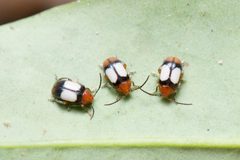
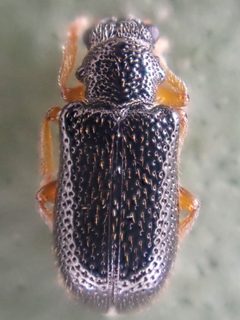
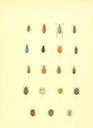
Pronunciation
How to pronounce Zeugophora: //ˌzjuːɡəˈfɔːrə//
These audio files are automatically generated. While they are not always 100% accurate, they are a good starting point.
Identification
-level identification relies heavily on examination of external male genitalia, including the lobe, median struts, tegmen, internal sac, and spiculum (9th abdominal segment). Subgenus assignment can be inferred from plant : Salicaceae associates indicate subgenus Zeugophora, while Celastraceae, Symplocaceae, or Lamiaceae associates indicate subgenus Pedrillia. Detailed morphological comparison with described species is necessary for accurate determination.
Images
Distribution
Documented from China (including Beijing, Gansu, Guizhou, Hunan, Inner Mongolia, Liaoning, Ningxia Hui Autonomous Region, Qinghai, Shaanxi, Sichuan, and Yunnan), with additional records from Denmark, Norway, and Sweden.
Diet
Phytophagous: larvae and feed on plant foliage. Documented host associations include Salicaceae (Populus nigra var. italica, P. alba, P. acuminata, P. deltoides, P. grandidentata, P. nigra, P. tremula, Populus spp., Salix spp.), Celastraceae (Euonymus alatus, E. przewalskii, E. phellomanus, E. maacki, E. sacrosancta, E. hamiltonianus, Celastrus orbiculatus), Symplocaceae (Symplocos sumuntia, Symplocos spp.), and Lamiaceae (Vitex quinata).
Host Associations
- Populus nigra var. italica - food plantsubgenus Zeugophora
- Populus alba - food plantsubgenus Zeugophora
- Populus acuminata - food plantsubgenus Zeugophora
- Populus deltoides - food plantsubgenus Zeugophora
- Populus grandidentata - food plantsubgenus Zeugophora
- Populus nigra - food plantsubgenus Zeugophora
- Populus tremula - food plantsubgenus Zeugophora
- Salix - food plantsubgenus Zeugophora
- Euonymus alatus - food plantsubgenus Pedrillia
- Euonymus przewalskii - food plantsubgenus Pedrillia
- Euonymus phellomanus - food plantsubgenus Pedrillia
- Euonymus maacki - food plantsubgenus Pedrillia
- Euonymus sacrosancta - food plantsubgenus Pedrillia
- Euonymus hamiltonianus - food plantsubgenus Pedrillia
- Celastrus orbiculatus - food plantsubgenus Pedrillia
- Symplocos sumuntia - food plantsubgenus Pedrillia
- Symplocos - food plantsubgenus Pedrillia
- Vitex quinata - food plantsubgenus Pedrillia
Behavior
Specimens have been collected by beating plants. Host plant associations differ between subgenera: subgenus Zeugophora is associated with Salicaceae (Populus and Salix), while subgenus Pedrillia is associated with Celastraceae, Symplocaceae, and Lamiaceae.
Similar Taxa
- MegalopisBoth belong to Megalopodidae; Zeugophora distinguished by Zeugophorinae placement and associated male genitalia characteristics used for identification.
- PalophagusBoth in Megalopididae; Zeugophora separated by documented plant specificity and male genitalia diagnostic at level.
More Details
Subgeneric classification
Pedrillia is accepted as a subgenus of Zeugophora based on external , male genitalia structure, and plant differences. This classification is supported by comparative study of 21 Chinese .
Taxonomic note
Some sources (e.g., NCBI) list as Zeugophoridae, but this is currently placed in Megalopodidae, Zeugophorinae, following modern classifications.