
Capraita subvittata
(Horn, 1889)
Belly-banded Flea Beetle
Capraita subvittata, commonly known as the Belly-banded Flea Beetle, is a of flea beetle in the Chrysomelidae. It is native to North America, with documented records from Canada (Alberta, Manitoba, New Brunswick) and the United States. As a member of the flea beetle tribe Alticini, it possesses enlarged hind adapted for jumping.
Pronunciation
How to pronounce Capraita subvittata: /kəˈpraɪtə ˌsʌbvɪˈtɑːtə/
These audio files are automatically generated. While they are not always 100% accurate, they are a good starting point.
Identification
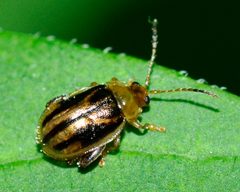
The "Belly-banded Flea Beetle" suggests a distinctive pale or light-colored band across the surface. Flea beetles in the Capraita are generally small, compact beetles with the characteristic enlarged hind legs of the tribe Alticini. Specific diagnostic features distinguishing C. subvittata from are not well documented in available sources.
Images
Distribution
North America. Documented from Canada: Alberta, Manitoba, New Brunswick. Distribution within the United States is implied by the North American range but specific states are not listed in available sources.
Similar Taxa
- Other Capraita species share the same -level and may require examination of subtle characters for separation; the belly-banded pattern may help distinguish C. subvittata from some relatives.
- Other flea beetles (Alticini)All possess enlarged hind for jumping; identification to and requires examination of specific morphological characters not detailed in available sources.
More Details
Etymology
The specific epithet "subvittata" derives from Latin roots suggesting "under" (sub-) and "banded" or "striped" (vittata), consistent with the "Belly-banded Flea Beetle" referring to a banding pattern.
Taxonomic authority
First described by George Henry Horn in 1889, a prominent American entomologist of the late 19th century.